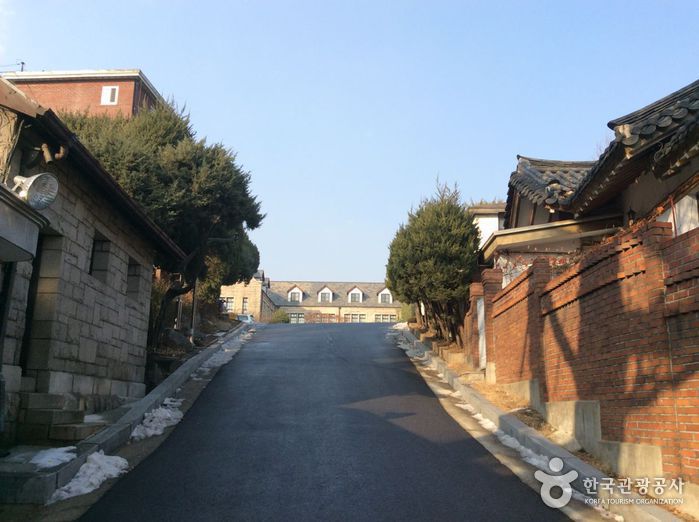
Choong Ang High School (중앙고등학교)
2.6Km 2025-10-23
164 Changdeokgung-gil, Jongno-gu, Seoul
+82-2-742-1321
Choong Ang High School is located in Jong-ro near Samcheongdong-gil. It was built to educate the public at the beginning of the 20th century. The school’s main building was reconstructed in 1937 after the original two-story brick house was destroyed in 1934. The main building situated in front of the main gate is a two-story H-shaped granite stone building in Gothic style, with a four-story tower in the middle.
The school holds historical significance because it was designed by Park Dong Jin, one of Korea's first modern architects and the designer of Korea University’s main building, library, and the Chosun Ilbo Newspaper Company building. The main building of Choong Ang High School is designated as Historic Site No. 281. Many national leaders were educated at the gothic building during the grim period when Korea was trying to escape Japanese colonial rule.

Seodaemun Prison History Museum (서대문형무소역사관)
2.6Km 2024-12-02
251 Tongil-ro, Seodaemun-gu, Seoul
Seodaemun Prison was built under the Japanese administration to imprison independence movement activists. It first opened on October 21, 1908 under the name Gyeongseong Prison. Eventually, so many activists were imprisoned that the building had to be expanded. At that time, the name changed to Seodaemun Prison on September 3, 1912. Eighty years later, the prison was turned into Seodaemun Independence Park on August 15, 1992 to commemorate the Korean patriots who were tortured in prison, giving their lives for freedom. Of the many buildings, only seven were preserved for their historical significance, among which three prison buildings and the execution site were designated as a Historic Site. In 1998, the park underwent another transformation into today's Seodaemun Prison History Hall to educate the public on the importance of Korea's independence and the sacrifices of those who fought to achieve it.
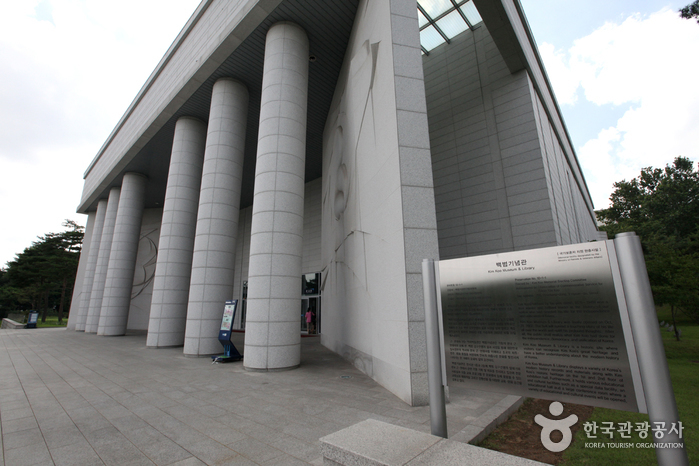
Kim Koo Museum & Library (백범김구기념관)
2.6Km 2022-08-30
26, Imjeong-ro, Yongsan-gu, Seoul
+82-2-799-3400
Kim Koo Museum & Library was built in Yongsan-gu, Seoul to commemorate Baekbeom Kim Koo (1876-1949), a highly respected Korean independence activist. It opened on October 22, 2002 to commemorate Kim Koo's efforts and achievements in Korean history. The main hall is comprised of two floors, exhibiting relics related to his entire life. A statue of a seated Kim Koo is situated in the central space of the first hall.
Namsan Outdoor Botanical Garden (남산 야외식물원)
2.6Km 2022-12-16
323, Sowol-ro, Yongsan-gu, Seoul
+82-2-798-3771
Namsan Outdoor Botanical Garden opened its doors on February 18, 1997 in Hannam-dong, where the residential complex for foreigners once stood before it was demolished in 1994. Covering an area of around 59 ㎡, it is divided into 13 themed gardens with a total 117,132 plants from 269 species. Among this diversity, 60,912 plants from 129 species are tree types and 56,220 plants from 140 species are grass types.
![CAPO FOOTBALL STORE[Korea Quality]/카포 풋볼 스토어[한국관광 품질인증]](http://tong.visitkorea.or.kr/cms/resource/88/2591988_image2_1.jpg)
CAPO FOOTBALL STORE[Korea Quality]/카포 풋볼 스토어[한국관광 품질인증]
2.6Km 2024-08-20
282 , Eulji-ro, Jung-gu, Seoul
+82-10-8922-7981
Located in Eulji-ro, Jung-gu, Seoul, Capo Football store is the largest football store in Korea. It stocks football boots of various levels, plus fan wear, uniforms, and training wear. On the 5th floor, a customer lounge provides free coffee, a football book cafe, a PlayStation for enjoying FIFA games, table soccer, and an exhibition of capo collections.
Dongnimmun Gate (독립문)
2.6Km 2022-12-15
251, Tongil-ro, Seodaemun-gu, Seoul
Dongnimmun stands at the location originally known as Yeongeun, where envoys were once treated. When a Chinese envoy visited, the King would go out through this door to greet. In 1898, to announce the independence from Japan, Dongnimun was constructed with the fund collected by the citizens. The traces of the past still remain on Dongnimmun with two pillars in front of Dongnimmun being the remains of Yeongeunmun.
The Arc de Triomphe in France can be recalled in comparison to Dongnimmun. Dongnimmun was built using granite with a passageway x_height of 14.28 meters. On the top it is written ‘Dongnimmun’ in Korean with the national flag drawn on each side. On the inner-left side there are stone stairs leading to the attic. The national flower Mugunghwa are planted around Dongnimmun. Now it is surrounded by roads and it is eye-catching to view when passing by.
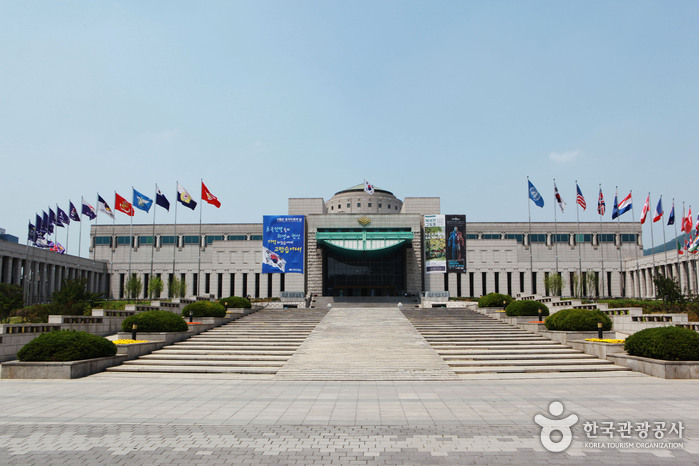
The War Memorial of Korea (전쟁기념관)
2.6Km 2022-12-29
29, Itaewon-ro, Yongsan-gu, Seoul
+82-2-709-3144
The War Memorial of Korea, located in Yongsan-gu, Seoul, exhibits and preserves materials related to the Korean War and serves as a national moral educational venue. It was established on June 10, 1994 by the War Memorial Service Korea Society to commemorate the noble sacrifice of patriotic martyrs. The museum houses approximately 33,000 artifacts with about 10,000 on display at indoor and outdoor exhibitions. There are six separate indoor halls, including Expeditionary Forces Room, Patriotic Memorial Room, War History Room, 6·25 Korean War Room, Development Hall and Large Machinery Room. The outdoor exhibition showcases large-sized weapons. Visitors of all ages from children to adults can also participate in 20 various educational programs and diverse cultural events such as military music and honor guard events, drawing contest, cultural event and more. The character of War Memorial of Korea is ‘Mudori’ featuring a helmet symbolizing the protection of the nation and a bay leaf meaning peace.
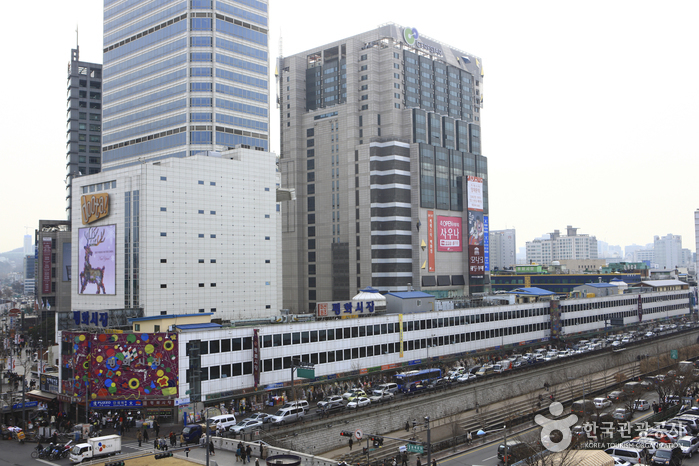
Dongdaemun Shopping Complex·Dongdaemun Shopping Town (동대문 종합시장·동대문 쇼핑타운)
2.6Km 2025-06-30
266 Jong-ro, Jongno-gu, Seoul
+82-2-2262-0114
Dongdaemun Shopping Complex is one of Korea’s most well-known markets. It was founded in December 1970 as the largest of its kind in Asia and has maintained that status for the last 40 years. Browsing the plethora of shops, you can find fabric and clothing following all the latest global fashion trends. Dongdaemun Shopping Complex continues to build up its reputation as a hub of international design.
The Museum of Medicine (서울대학교병원의학박물관)
2.6Km 2024-03-18
101 Daehak-ro, Jongno-gu, Seoul
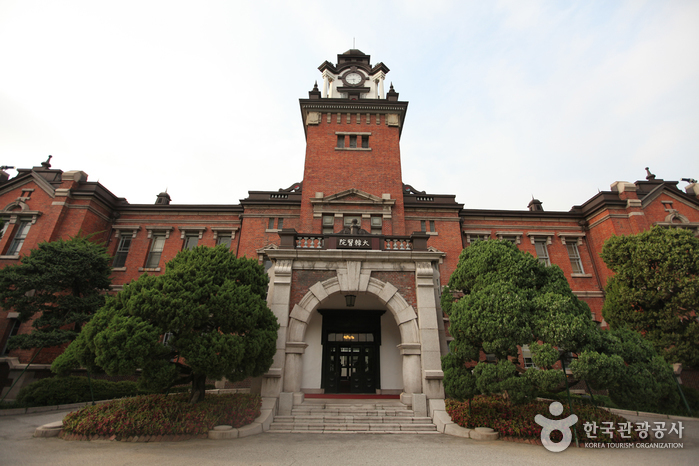
The Museum of Medicine is located in the building of the former Daehan Medical Center, the oldest modern hospital in Korea. It is a medical museum that provides a comprehensive view of the development of modern medicine in Korea, the history of medical devices, and the transformation of Seoul National University Hospital. Through permanent and special exhibitions, the museum showcases medical artifacts and documents related to the history of medicine.
Pyounghwa (Pyeonghwa) Fashion Town (서울 평화시장)
2.6Km 2025-01-06
274, Cheonggyecheon-ro, Jung-gu, Seoul
+82-2-2265-3531~3
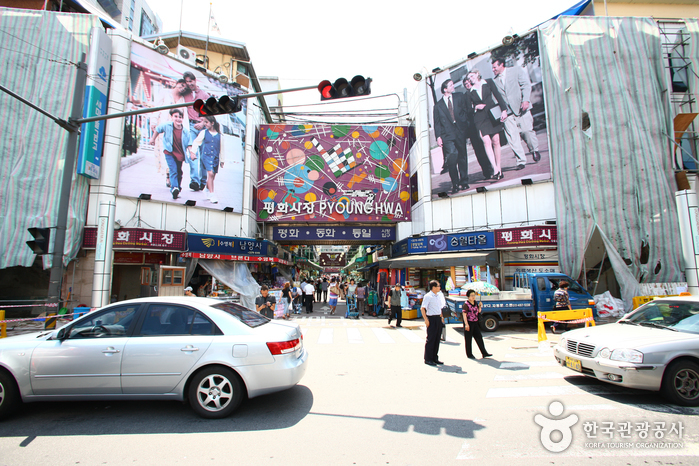
The Pyounghwa Fashion Town market in Dongdaemun has been selling fashion clothing and accessories for over 50 years ever since the end of the Korean War. It was here that in 1953 North Korean refugees started selling clothes made from US army uniforms. Their market was then named Pyounghwa, which means peace, in the hope that no other wars would be fought on Korean soil. The Pyounghwa Fashion Town was therefore the beginning of the 30,000 stores that now make up Dongdaemun Fashion Town, which is seen as one of the global centers of the fashion industry.
Spread over a large area, this historical fashion market is divided into several districts, the ‘Gu Pyounghwa Fashion Town’ is the oldest, and there is also the ‘Shin Pyounghwa Fashion Town’, ‘Dong Pyounghwa Fashion Town’, and ‘Cheong Pyounghwa Fashion Town’.
 English
 한국어
한국어 日本語
日本語 中文(简体)
 Deutsch
 Français
 Español
 Русский


