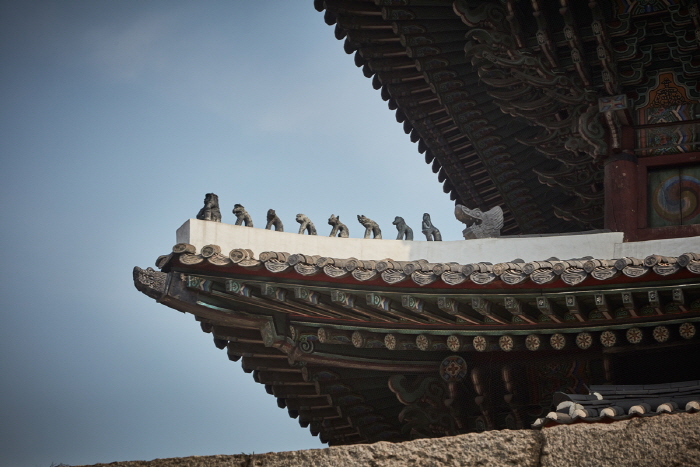
Heunginjimun Gate - Dongdaemun Gate (흥인지문)
18.6Km 2025-10-23
288, Jong-ro, Jongno-gu, Seoul
+82-2-2148-1842
Heunginjimun Gate was built to protect Hanseongbu, which historically housed essential government facilities. Heunginjimun Gate was the gate on the east side of the outer wall of Seoul Fortress among eight gates. It is referred to as Dongdaemun Gate as well. The gate was constructed during King Taejo’s 5th year in 1396, remodeled during the reign of King Danjong in 1453, and was newly built in 1869 during the sixth year of King Gojong’s reign in 1869.
The gate features a hipped roof with five front and two side compartments on a two-storied building. The thin and weak bracket system supports the eaves and is excessively decorated, reflecting the construction features of the late Joseon period. Also, outside of the fortress is the half-circle-shaped Ongseong, a small wall, to protect the gate.
One of the unique factors of Heunginjimun Gate is that it is the only gate among Seoul’s eight to have Ongseong, further exhibiting the style of construction used during the late Joseon period.


I Love Sindangdong Tteokbokki (아이러브신당동떡볶이)
18.6Km 2024-03-07
50, Toegye-ro 76-gil, Jung-gu, Seoul
+82-2-2232-7872
Situated in Sindang-dong Tteokbokki Town, I Love Sindangdong Tteokbokki is a famous tteokbokki restaurant. Tteokbokki is a typical Korean street food, consisting of rice cakes made with flour or rice flour and stir-fried in red chili paste. The rice cakes are simmered in a broth with seasonings, along with fish cakes, vegetables, boiled eggs, mandu, and other ingredients. The best thing is that the dish can be customized with various ingredients such as cheese, ramyeon noodles, chewy noodles, and ham. Leftover broth can be fried with rice for a satisfying meal.
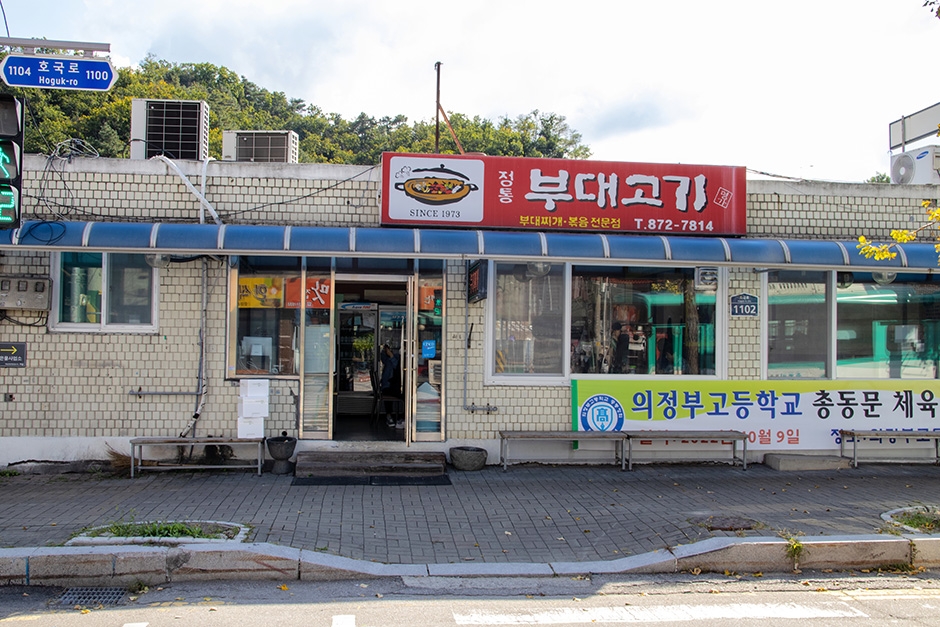
Jeongtong Budaegogi (정통부대고기)
18.6Km 2024-12-23
경기도 의정부시 호국로 1102
Opened in 1973, this budaejjigae (Sausage Jjigae) restaurant is known for its exceptional flavor, achieved through spicy kimchi and a carefully crafted broth. Another popular menu item is budaebokkeum, a stir-fried, soupless version of the classic jjigae.
 English
 한국어
한국어 日本語
日本語 中文(简体)
 Deutsch
 Français
 Español
 Русский


