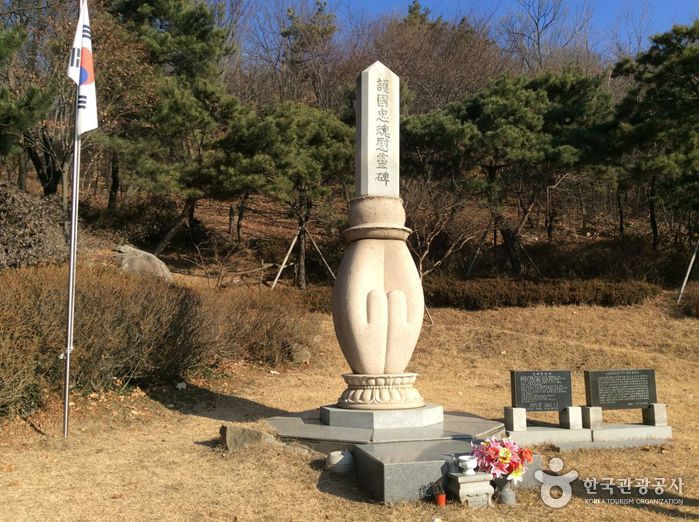
Memorial to the Loyal Dead (호국충혼위령비)
10.6Km 2025-01-13
56-33, Gaehwadong-ro 13-gil, Gangseo-gu, Seoul
+82-2-2125-0848
When the fate of the nation was hanging by a thread as the North Korean Army launched an invasion of the South on June 25, 1950, about 1,100 officers and men from
the South Korean First Division's 11th, 12th, and 15th regiment retreated to Gimpo and built the last line of defense on Gaehwasan Mountain from June 26 to 30 to fight against a large army
of North Korean soldiers disguised as South Korean men.
Unfortunately, their communication with the headquarters was
cut off and their supply of ammunition and food ran out. As a result, the entire South Korean force was killed by the much larger North Korean army
in a valley around Gaehwasan Mountain. In order to commemorate those who died for the country, the government established the
Memorial to the Loyal Dead on Gaehwasan Mountain in 1994. A memorial service is
also held here annualy on June 28th.
x_height: 4.7 meters high
Built by the First Division of the ROK Army, Mitasa Temple

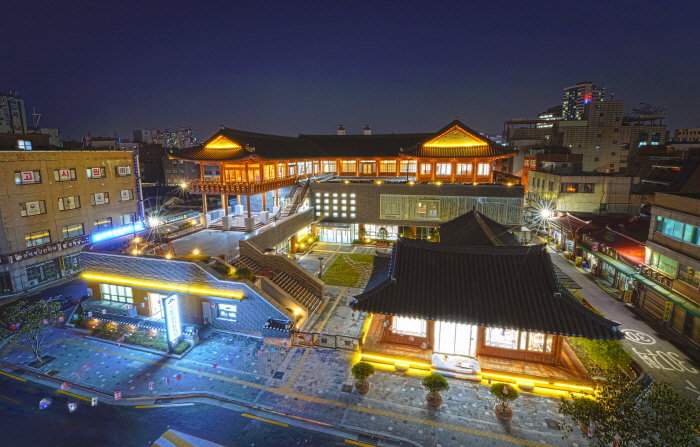
Seoul K-Medi Center (서울한방진흥센터)
10.6Km 2025-10-23
26 Yangnyeongjungang-ro, Dongdaemun-gu, Seoul
Seoul Yangnyeongsi Market is an herbal medicine specialty market that distributes 70% of the herbal medicines traded in Korea and is a Korean medicine-themed town with over a thousand businesses related to oriental medicine, including oriental medicine clinics and herbal medicine stores. The Seoul K-Medi Center, located in this center of Korean herbal medicine culture, is an oriental medicine complex cultural facility that promotes the excellence and safety of traditional Korean medicine through various exhibitions, education, and experiences. The building is unique in that it harmonizes the simplicity of modern architecture with Korean elegance. Visitors can enjoy various experiences in many different facilities in the center, including the Herb Medicine Museum, where one can expand their understanding of Korean medicine by examining over 300 types of medicinal herbs and their effects; the Herb Medicine Experience Room, where visitors can experience herbal medicine natural face packs and herbal heat packs; and Yakseon Food Experience Center, where visitors can learn about healthy recipes using medicinal herbs and make healthy foods.
Seoul Doseonsa Temple (도선사(서울))
10.7Km 2025-06-25
504 Samyang-ro 173-gil, Gangbuk-gu, Seoul
Doseonsa Temple was established 1,100 years ago during the latter part of the Silla Kingdom when the renowned Buddhist priest Doseonguksa was traveling through the mountains. After visiting the site, Doseonguksa made a prophecy that led to the construction of the temple. According to legend, he used only his walking stick to carve the large Bodhisattva that sits at the temple. Interestingly enough, the statue does not show any evidence of chisel marks, further adding to the mystery of how the statue was made.
During the 7th year of King Gwangmu of the Joseon dynasty, Doseonsa Temple was officially named the representative temple of Korea with the purpose of promoting Cheongdamdaejongsa's Korean Buddhism movement, aiming at a religious revival. Due to these special circumstances Deseonsa Temple gained a high reputation and much recognition, which have held strong to this day.
Inside the temple, visitors can view the remains and written works of Cheongdamdaejongsa in the Cheongdamdaejongsa Memorial Hall. Next to the road leading to Cheonbuljeon Hall is a pond where you can toss a coin and make a wish and just past Yongammun Gate is a hiking path connecting Baegundae Cliff and Insubong Peak. Inside the Ksitigarbha Hall are portraits of President Park Chung-hee, Yuk Yeong-su, and Hyundai Chairman Chung Ju-yung. In front of the hall is a tree that is said to have been planted by a Buddhist priest who brought it from India 200 years ago. Historical artifacts can be found throughout the temple.
Seoul Yangnyeongsi Herb Medicine Museum (서울약령시 한의약박물관)
10.7Km 2023-04-06
26, Yangnyeongjungang-ro, Dongdaemun-gu, Seoul
+82-2-969-9241
Seoul Yangnyeongsi Herb Medicine Museum opened in September 2006 on the grounds of Bojewon, a medical institution for the poor that was in operation during the Joseon dynasty. The museum was established with the goal of preserving and developing Korea’s herb medicine culture. In October 2017, the museum moved to the second floor of the Seoul K-Medi Center. The center provides both information and hands-on programs.
Nature Republic - Homeplus Wolgok Branch [Tax Refund Shop] (네이쳐리퍼블릭 홈플러스월곡점)
10.7Km 2024-04-23
76, Hwarang-ro, Seongbuk-gu, Seoul
-
Olive Young - Homeplus Wolgok Branch [Tax Refund Shop] (올리브영 홈플러스월곡)
10.7Km 2024-04-17
Home Plus Wolgok Branch, 76, Hwarang-ro, Seongbuk-gu, Seoul
-
![Bukhansan Dulle Trail Section 1 ([북한산 둘레길] 1 소나무숲길 )](http://tong.visitkorea.or.kr/cms/resource/30/1898430_image2_1.jpg)
Bukhansan Dulle Trail Section 1 ([북한산 둘레길] 1 소나무숲길 )
10.7Km 2024-01-04
12 Samyang-ro 173-gil, Gangbuk-gu, Seoul
Bukhansan Mountain is a mountain representing Seoul, which 5 million people visit every year. It is not easy to hike up to the top, but the dulle trail allows one to enjoy the beauty of the mountain without too much effort. Bukhansan Dulle Trail is a low-lying, horizontal walking trail created by connecting and refining existing side paths, allowing for a leisurely walk along the foot of the mountain. The Pine Forest Trail, one section of the trail consisting of 21 themes, is 2.9 kilometers long from the entrance to Uiryeong Trail to the top of Solbat Neighborhood Park. It is filled with majestic pine trees, and the road is wide and gentle, making it a perfect place to enjoy a walk. Most of the section is shaded by trees, so visitors can feel cool while walking up even on hot summer days.
Himart - Singil Branch [Tax Refund Shop] (하이마트 신길점)
10.7Km 2024-04-22
141, Singil-ro, Yeongdeungpo-gu, Seoul
-
Choi Hyeok Korean Medicine Clinic (최혁한의원)
10.7Km 2025-10-23
(1st Floor), 52 Yangnyeongdong-gil, Dongdaemun-gu, Seoul
Choi Hyeok Korean Medicine Clinic is particularly popular among Japanese visitors. Words about our affordable prices, friendly services, and dedication of the chief and the staff have spread in Japan, which has attracted over 2,000 Japanese visitors to the clinic annually. We offer an extensive array of services, including skin care, wrinkle removal, bloodletting acupuncture, weight-loss herbal medicine (hanyak), lipolysis acupuncture, gongjindan, kyungokgo, and “Magic Powder.” We accept appointments for wrinkle therapy on Sundays. We deliver hanyak to patients’ hotels if they are not too far away. We also ship to patients’ homes in Japan. You are always welcome to contact us on Line or Instagram.
Hyosajeong Pavilion (효사정)
10.7Km 2025-01-13
55, Hyeonchung-ro, Dongjak-gu, Seoul
+82-2-820-9848
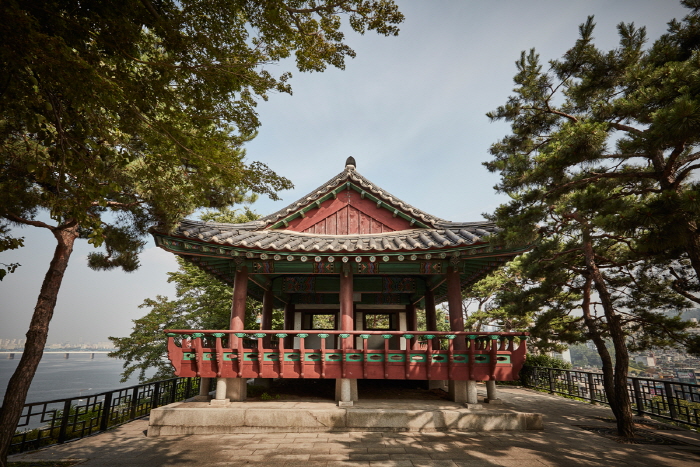
Hyosajeong Pavilion is where Nohan, the second vice premier of the Joseon dynasty during King Sejong and King Sejo’s reign, stayed. After he lost his mother, he built the pavilion to mourn at her grave while still being able to see his father’s grave in Gaeseong to the North. His brother-in-law, then Minister of the Interior, Gang Sa-deok named the pavilion “Hyosajeong,” which means pavilion of filial piety.
In order to find the original location of the pavilion, poems by Jeong Inji and Seo Geojeong and an old map of Korea were referenced, but the pavilion was not found because the surrounding landscape had changed too much. As a result, a location was selected and the pavilion was reconstructed at its current location. The house is 3 kan* in the front and 2 kan* on the side. The roof is a hip-and-gable roof. The pavilion has one room with under floor heating and a railing around the pavilion
(* kan: a traditional measurement that corresponds to the space between two columns)
 English
 한국어
한국어 日本語
日本語 中文(简体)
 Deutsch
 Français
 Español
 Русский


