
Artbox - Jongno 3(sam)-ga Branch [Tax Refund Shop] (아트박스 종로3가)
7.1Km 2024-04-17
126, Jong-ro, Jongno-gu, Seoul
-
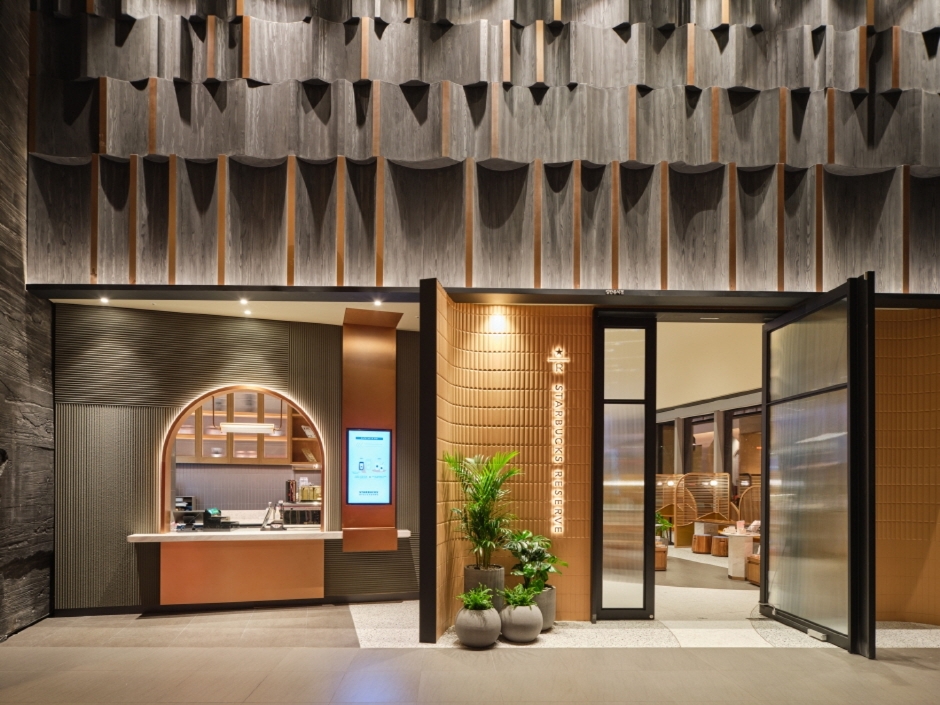
Starbucks Byuldabang (스타벅스 별다방)
7.1Km 2024-12-27
100 Toegye-ro, Jung-gu, Seoul
Byuldabang is a cozy space in the city, where the present and future of Starbucks coexist
Byuldabang is a special name. It combines the Korean words byul, which means stars, and dabang, which means a traditional space where people gather and talk over tea or drink. Byuldabang is the nickname Koreans generally use for Starbucks. Starbucks Byuldabang store opened in appreciation of customers of Starbucks Korea, celebrating its 22nd anniversary. This particular store is a Starbucks Reserve store with new concept food items, and is the first among Starbucks stores worldwide to have digital art wall decorations. The images projected to the art wall are “The Journey of Siren.” It is a surreal journey of Siren, who delivers coffee messages around the ocean, day and night. Customers love the story.
![EW Spao - Myeong-dong Branch [Tax Refund Shop] (EW 스파오 명동)](http://tong.visitkorea.or.kr/cms/resource/12/2878612_image2_1.jpg)
EW Spao - Myeong-dong Branch [Tax Refund Shop] (EW 스파오 명동)
7.1Km 2024-04-17
15, Myeongdong 8na-gil, Jung-gu, Seoul
-
The Clim Clinic (더끌림산부인과의원)
7.1Km 2025-10-23
(12th Floor, 2431 Building),109 Toegye-ro, Jung-gu, Seoul
For your healthy and beautiful life,
The Clim: Women Care Medical Group is always here for you.
At The Clim, female medical staff from Samsung Medical Center offer one-on-one consultations and personalized treatments.
Our all-female medical team provides emphatic care, understanding our patients better than anyone else.
We always listen to and address your deepest worries with warm-hearted treatment that is attuned to the needs of women, delivered by medical staff who possess both skills and expertise.
Our team consists solely of female obstetrician/gynecologists who have a deep empathy and understanding for their patients, ensuring that each patient feels more comfortable and satisfied with their procedures.
Drawing on our extensive experience, we promise to carefully consider each patient's unique physical structure, characteristics, and concerns, allowing us to effectively address even the most profound worries.
![Ziozia Ssts - Myeong-dong Branch [Tax Refund Shop] (지오지아 SSTS 명동점)](http://tong.visitkorea.or.kr/cms/resource/21/2891121_image2_1.jpg)
Ziozia Ssts - Myeong-dong Branch [Tax Refund Shop] (지오지아 SSTS 명동점)
7.1Km 2024-04-22
6, Myeongdong 8na-gil, Jung-gu, Seoul
-
Arumdaun Nara Dermatology Clinic - Myeongdong (아름다운나라피부과의원 명동점)
7.1Km 2025-11-21
4th Floor, 6 Myeongdong 8na-gil, Jung-gu, Seoul
Founded in 2000. Our clinic is led by a board-certified dermatologist. One of only 2% of doctors in Korea who are certified dermatology specialists who personally provides all consultations and treatments.
![Innisfree - Myeong-dong 2(i)-ga Branch [Tax Refund Shop] (이니스프리 명동2가점)](http://tong.visitkorea.or.kr/cms/resource/70/2887870_image2_1.jpg)
Innisfree - Myeong-dong 2(i)-ga Branch [Tax Refund Shop] (이니스프리 명동2가점)
7.1Km 2024-04-22
1F, 2F (Myeongdong 2-ga), 27, Myeongdong 10-gil, Jung-gu, Seoul
-
Happy Jewerly [Tax Refund Shop] (해피쥬얼리)
7.2Km 2024-06-27
1F, #21, 26, Donhwamun-ro, Jongno-gu, Seoul
-
The Saem - Myeong-dong Branch (No. 1) [Tax Refund Shop] (더샘 명동1호점)
7.2Km 2024-04-16
41, Myeongdong 8-gil, Jung-gu, Seoul
-
 English
 한국어
한국어 日本語
日本語 中文(简体)
 Deutsch
 Français
 Español
 Русский


