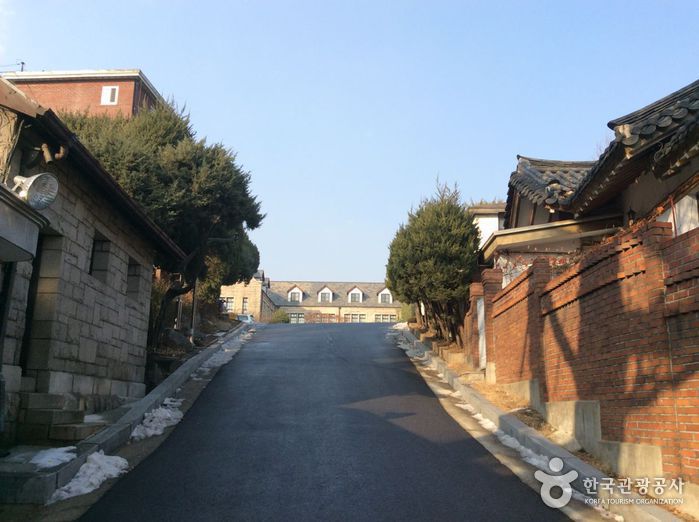
Choong Ang High School (중앙고등학교)
2.2Km 2025-10-23
164 Changdeokgung-gil, Jongno-gu, Seoul
+82-2-742-1321
Choong Ang High School is located in Jong-ro near Samcheongdong-gil. It was built to educate the public at the beginning of the 20th century. The school’s main building was reconstructed in 1937 after the original two-story brick house was destroyed in 1934. The main building situated in front of the main gate is a two-story H-shaped granite stone building in Gothic style, with a four-story tower in the middle.
The school holds historical significance because it was designed by Park Dong Jin, one of Korea's first modern architects and the designer of Korea University’s main building, library, and the Chosun Ilbo Newspaper Company building. The main building of Choong Ang High School is designated as Historic Site No. 281. Many national leaders were educated at the gothic building during the grim period when Korea was trying to escape Japanese colonial rule.
![Alive Museum (Insa-dong Branch) [박물관은 살아있다(인사동점)]](http://tong.visitkorea.or.kr/cms/resource/27/3109227_image2_1.JPG)
Alive Museum (Insa-dong Branch) [박물관은 살아있다(인사동점)]
2.2Km 2024-03-15
(B1 and B2, Daeil Building), 12, Insadong-gil, Jongno-gu, Seoul
+82-2-1544-8506
The Alive Museum is a media theme park located in Insa-dong. The exhibition here is made up of optical illusion art, large objet, and digital media pieces, which allow you to delve into the land of mystery. It is made up of different sections like the Insadong Photo Studio, Game Village, and the Toy Village.
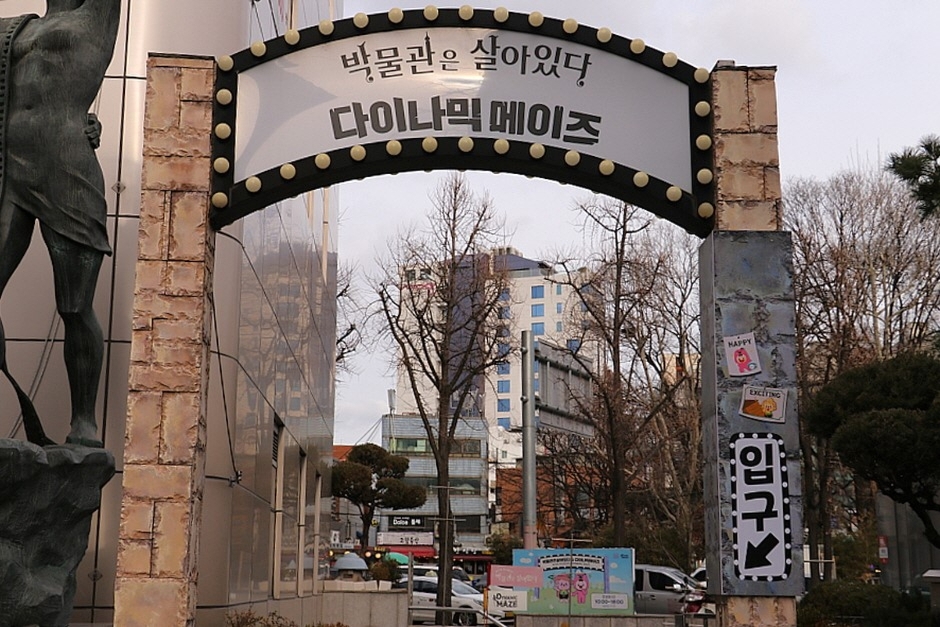
Dynamic Maze (Insa-dong) (다이나믹 메이즈 (서울 인사동점))
2.2Km 2024-03-15
12, Insadong-gil, Jongno-gu, Seoul
+82-1544-8506
Dynamic Maze is an indoor space in Insa-dong dedicated to an exciting adventure: A maze filled with obstacles, requiring participants to work together and overcome the barriers through quickness and focus. Go through the hall of mirrors, climb the wall, and cross the suspension bridge to finally escape from the maze.
![V Spa - Lotte Avenuel Branch [Tax Refund Shop] (브이스파 롯데에비뉴엘)](http://tong.visitkorea.or.kr/cms/resource/04/2888404_image2_1.jpg)
V Spa - Lotte Avenuel Branch [Tax Refund Shop] (브이스파 롯데에비뉴엘)
2.2Km 2024-04-18
10F, 73, Namdaemun-ro, Jung-gu, Seoul
-
![CH Carolina Herrera - Avenuel Branch [Tax Refund Shop] (CH캐롤리나헤레라 에비뉴엘)](http://tong.visitkorea.or.kr/cms/resource/07/2888707_image2_1.jpg)
CH Carolina Herrera - Avenuel Branch [Tax Refund Shop] (CH캐롤리나헤레라 에비뉴엘)
2.2Km 2024-04-19
4F Lotte Department Store Main Branch AVENUEL, 73, Namdaemun-ro, Jung-gu, Seoul
-
![BVLGARI - Lotte Avenuel Branch [Tax Refund Shop] (불가리 롯데 에비뉴엘점)](http://tong.visitkorea.or.kr/cms/resource/58/2889758_image2_1.jpg)
BVLGARI - Lotte Avenuel Branch [Tax Refund Shop] (불가리 롯데 에비뉴엘점)
2.2Km 2024-04-18
73, Namdaemun-ro, Jung-gu, Seoul
-
![Cartier - Lotte Avenuel Branch [Tax Refund Shop] (까르띠에 롯데에비뉴엘점)](http://tong.visitkorea.or.kr/cms/resource/88/2889788_image2_1.jpg)
Cartier - Lotte Avenuel Branch [Tax Refund Shop] (까르띠에 롯데에비뉴엘점)
2.2Km 2024-04-23
124, Singomae-ro, Giheung-gu, Yongin-si, Gyeonggi-do
-
![Burberry - Lotte Avenuel Branch [Tax Refund Shop] (버버리 롯데 에비뉴엘점)](http://tong.visitkorea.or.kr/cms/resource/29/2889829_image2_1.jpg)
Burberry - Lotte Avenuel Branch [Tax Refund Shop] (버버리 롯데 에비뉴엘점)
2.2Km 2024-04-18
73, Namdaemun-ro, Jung-gu, Seoul
-
![Piaget - Lotte Avenuel Branch [Tax Refund Shop] (피아제 롯데 에비뉴엘점)](http://tong.visitkorea.or.kr/cms/resource/72/2889872_image2_1.jpg)
Piaget - Lotte Avenuel Branch [Tax Refund Shop] (피아제 롯데 에비뉴엘점)
2.2Km 2024-04-18
73, Namdaemun-ro, Jung-gu, Seoul
-
![Insa Chilgi - Insa Branch [Tax Refund Shop] (인사칠기 인사)](http://tong.visitkorea.or.kr/cms/resource/18/2878218_image2_1.jpg)
Insa Chilgi - Insa Branch [Tax Refund Shop] (인사칠기 인사)
2.2Km 2024-04-22
5, Seolleung-ro 162-gil, Gangnam-gu, Seoul
-
 English
 한국어
한국어 日本語
日本語 中文(简体)
 Deutsch
 Français
 Español
 Русский


