![Golfzon Market - Yaksu Branch [Tax Refund Shop] (골프존마켓 약수)](http://tong.visitkorea.or.kr/cms/resource/43/2878743_image2_1.jpg)
Golfzon Market - Yaksu Branch [Tax Refund Shop] (골프존마켓 약수)
3.0Km 2024-04-19
214, Dongho-ro, Jung-gu, Seoul
-

Grand Hyatt Seoul (그랜드 하얏트 서울)
3.0Km 2025-10-23
322, Sowol-ro, Yongsan-gu, Seoul
+82-2-797-1234
The Grand Hyatt Seoul is an international business hotel located 10 minutes away from the center of the city and 20 minutes away from Yeouido and Gangnam, boasting a view of the Hangang River to the south and the scenery of Namsan Mountain to the north. It is also located only 70 minutes and 50 minutes away from Incheon International Airport and Gimpo International Airport respecitvely, making the hotel a convenient option for international travelers.
Grand Hyatt Seoul has twelve restaurants and bars that serve authentic meals and develop menus that lead the culinery trend. The hotel is also equipped with conference rooms, sports facilities, and spa services.

Tonymoly - Dongdaemun Branch [Tax Refund Shop] (토니모리 동대문)
3.0Km 2024-04-18
257, Jangchungdan-ro, Jung-gu, Seoul
-
![8th Avenue WithPharm Pharmacy [Tax Refund Shop] (8번가위드팜약국)](http://tong.visitkorea.or.kr/cms/resource/75/2890675_image2_1.jpg)
8th Avenue WithPharm Pharmacy [Tax Refund Shop] (8번가위드팜약국)
3.0Km 2024-04-19
515, Seongsan-ro, Seodaemun-gu, Seoul
-
![CAPO FOOTBALL STORE[Korea Quality]/카포 풋볼 스토어[한국관광 품질인증]](http://tong.visitkorea.or.kr/cms/resource/88/2591988_image2_1.jpg)
CAPO FOOTBALL STORE[Korea Quality]/카포 풋볼 스토어[한국관광 품질인증]
3.0Km 2024-08-20
282 , Eulji-ro, Jung-gu, Seoul
+82-10-8922-7981
Located in Eulji-ro, Jung-gu, Seoul, Capo Football store is the largest football store in Korea. It stocks football boots of various levels, plus fan wear, uniforms, and training wear. On the 5th floor, a customer lounge provides free coffee, a football book cafe, a PlayStation for enjoying FIFA games, table soccer, and an exhibition of capo collections.
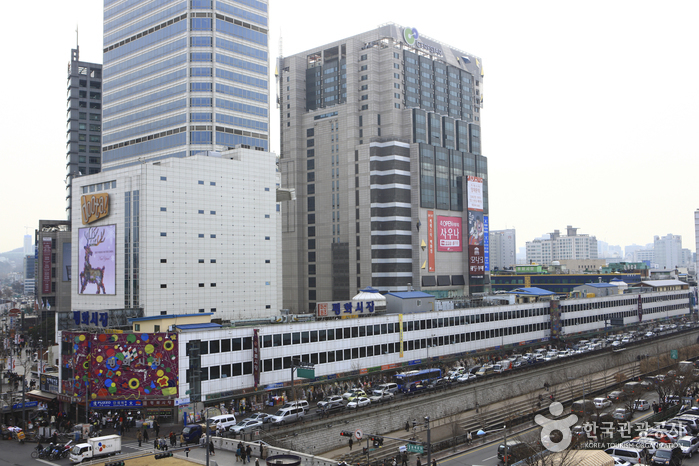
Dongdaemun Shopping Complex·Dongdaemun Shopping Town (동대문 종합시장·동대문 쇼핑타운)
3.0Km 2025-06-30
266 Jong-ro, Jongno-gu, Seoul
+82-2-2262-0114
Dongdaemun Shopping Complex is one of Korea’s most well-known markets. It was founded in December 1970 as the largest of its kind in Asia and has maintained that status for the last 40 years. Browsing the plethora of shops, you can find fabric and clothing following all the latest global fashion trends. Dongdaemun Shopping Complex continues to build up its reputation as a hub of international design.
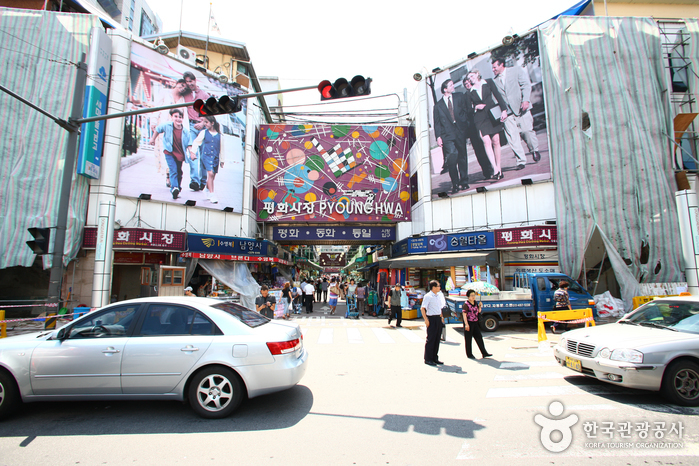
Pyounghwa (Pyeonghwa) Fashion Town (서울 평화시장)
3.0Km 2025-01-06
274, Cheonggyecheon-ro, Jung-gu, Seoul
+82-2-2265-3531~3
The Pyounghwa Fashion Town market in Dongdaemun has been selling fashion clothing and accessories for over 50 years ever since the end of the Korean War. It was here that in 1953 North Korean refugees started selling clothes made from US army uniforms. Their market was then named Pyounghwa, which means peace, in the hope that no other wars would be fought on Korean soil. The Pyounghwa Fashion Town was therefore the beginning of the 30,000 stores that now make up Dongdaemun Fashion Town, which is seen as one of the global centers of the fashion industry.
Spread over a large area, this historical fashion market is divided into several districts, the ‘Gu Pyounghwa Fashion Town’ is the oldest, and there is also the ‘Shin Pyounghwa Fashion Town’, ‘Dong Pyounghwa Fashion Town’, and ‘Cheong Pyounghwa Fashion Town’.
![Runners Club [Tax Refund Shop] (러너스클럽)](http://tong.visitkorea.or.kr/cms/resource/43/2891143_image2_1.jpg)
![Runners Club - Ewha Womans Univ. Branch [Tax Refund Shop] (러너스클럽 이대)](http://tong.visitkorea.or.kr/cms/resource/12/2889512_image2_1.jpg)
Runners Club - Ewha Womans Univ. Branch [Tax Refund Shop] (러너스클럽 이대)
3.0Km 2024-04-23
#103, 160, Sinchon-ro, Mapo-gu, Seoul
-
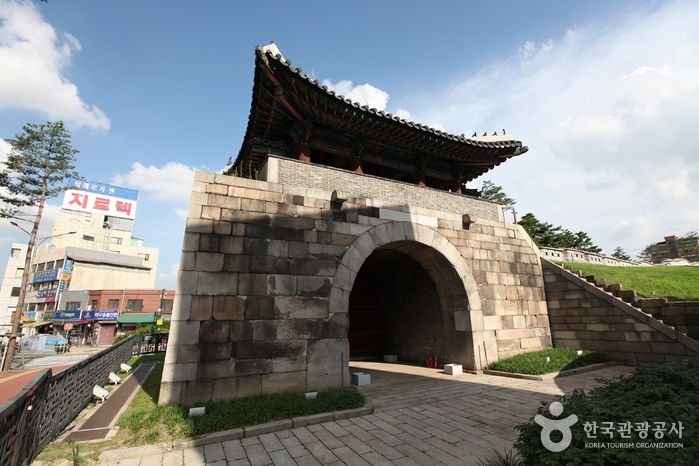
Gwanghuimun Gate (광희문)
3.0Km 2021-02-24
344, Toegye-ro, Jung-gu, Seoul
+82-2-3700-3900
Gwanghuimun Gate is said to have been originally constructed in 1396, the 5th year of King Taejo, at the southeast of the capital city. It was often referred to as Sugumun Gate (water channel gate) and was actually used as a Sigumun, literally meaning “corpse gate,” as funeral processions passed through this gate when exiting to the east.
During the Imjin War (1592-1598), the fortress gate was destroyed to such a degree that it made finding the original location close to impossible. Nevertheless, reconstruction efforts were started in 1711 (37th year of King Sukjong) and the gate was restored together with the gate's watchtower. Gwanghuimun Gate remained intact even when the fortress walls were demolished to build tram tracks during the Japanese occupation, but it was later damaged during the Korean War and left neglected. In 1975, restoration work was carried out to relocate Gwanghuimun Gate to a site 15 meters south of its original location since it stood in the middle of the road.
 English
 한국어
한국어 日本語
日本語 中文(简体)
 Deutsch
 Français
 Español
 Русский


