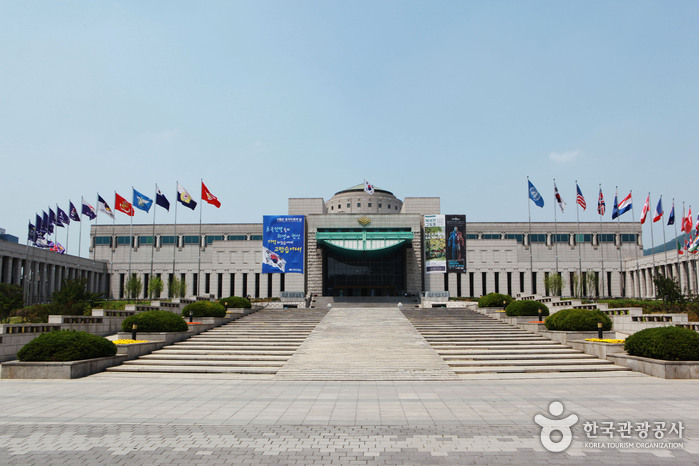
The War Memorial of Korea (전쟁기념관)
5.4Km 2022-12-29
29, Itaewon-ro, Yongsan-gu, Seoul
+82-2-709-3144
The War Memorial of Korea, located in Yongsan-gu, Seoul, exhibits and preserves materials related to the Korean War and serves as a national moral educational venue. It was established on June 10, 1994 by the War Memorial Service Korea Society to commemorate the noble sacrifice of patriotic martyrs. The museum houses approximately 33,000 artifacts with about 10,000 on display at indoor and outdoor exhibitions. There are six separate indoor halls, including Expeditionary Forces Room, Patriotic Memorial Room, War History Room, 6·25 Korean War Room, Development Hall and Large Machinery Room. The outdoor exhibition showcases large-sized weapons. Visitors of all ages from children to adults can also participate in 20 various educational programs and diverse cultural events such as military music and honor guard events, drawing contest, cultural event and more. The character of War Memorial of Korea is ‘Mudori’ featuring a helmet symbolizing the protection of the nation and a bay leaf meaning peace.
![Olive Young - Aeogae Station Branch [Tax Refund Shop] (올리브영 애오개역)](http://tong.visitkorea.or.kr/cms/resource/85/2888685_image2_1.jpg)
Olive Young - Aeogae Station Branch [Tax Refund Shop] (올리브영 애오개역)
5.4Km 2024-04-16
#107, and #108, 201, Mapo-daero, Mapo-gu, Seoul
-
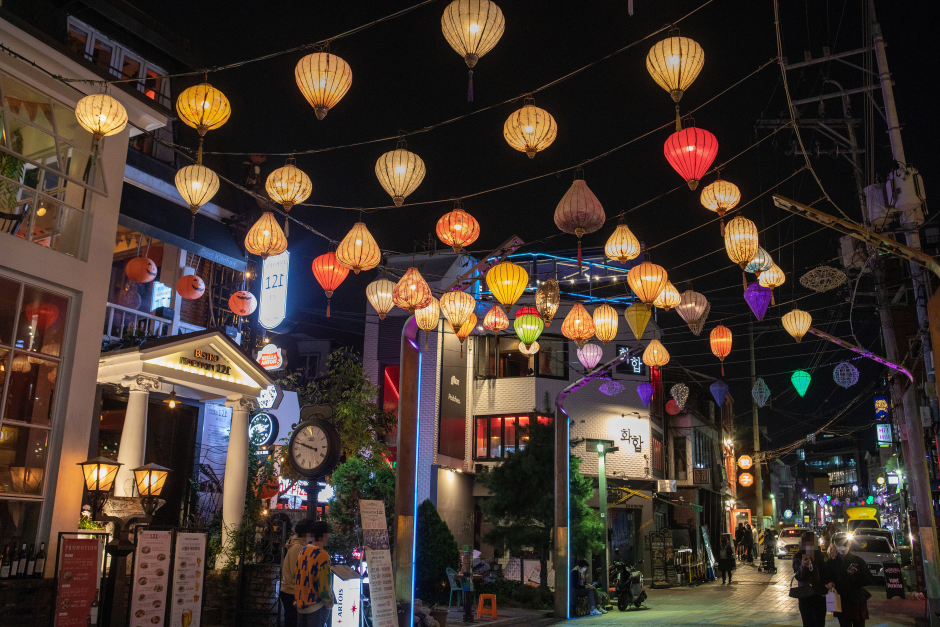
Itaewon Shopping Street (이태원 쇼핑거리)
5.4Km 2025-03-29
Itaewon-dong, Yongsan-gu, Seoul
+82-2-797-7319
Itaewon Shopping Street is a 1.4-kilometer-long road located near Itaewon Station. There is an enormous variety of shops, entertainment venues, and restaurants lined along both sides of the street. As the neighborhood has a reputation as a mini melting pot in Seoul where languages other than Korean are widely spoken, it is one of the most visited places by international visitors. It has become a gateway for many international visitors to receive services and information on basic tourist needs such as accommodations, shopping, tourist attractions, and more.
![Converse [Tax Refund Shop] (컨버스)](http://tong.visitkorea.or.kr/cms/resource/76/2891176_image2_1.jpg)

Seoul Upcycling Plaza (서울새활용플라자)
5.4Km 2024-01-05
49 Jadongchasijang-gil, Seongdong-gu, Seoul
Saehwaryong is a Korean term for upcycling, a process of redesigning or recycling discarded resources or materials to give them a new value or purpose. Seoul Upcycling Plaza operates upcycling-related exhibitions, upcycling practice education and experience programs, design studios, upcycling stores, workshops, and more. It is a great place to look around for ideas and inspirations on how to use products for longer periods of time. The plaza demonstrates the first step to creating a resource-recycling society.
Seoul Forest (서울숲)
5.4Km 2024-10-29
273 Ttukseom-ro, Seongdong-gu, Seoul
+82-2-460-2905
Seoul Forest is a city park opened on June 18, 2005 in what was originally a water treatment facility. Consisting of four themed parks spread over approximately 595,000 ㎡ of land, Seoul Forest is an eco-friendly zone appreciated not only by the people of the city but also those visiting Seoul.
Seoul Hyochang Park (서울 효창공원)
5.4Km 2024-07-09
177-18 Hyochangwon-ro, Yongsan-gu, Seoul
+82-2-2199-7608
Hyochang Park covers 122,245 square meters spanning across Hyochang-dong and Cheongpa 2-dong. It is a historic landmark that once contained several royal tombs, and was known at that time as Hyochangwon. The cemeteries that were originally located in Hyochangwon belonged to Crown Prince Munhyo, King Jeongjo’s first son who died at the age of five; Royal Noble Consort Uibin of the Seong Clan, King Jeongjo’s royal concubine and Crown Prince Munhyo’s mother; Royal Noble Consort Sugui of the Park Clan, King Sunjo’s royal concubine; and her daughter Princess Yeongon. The royal tombs were moved to Seooreung Tombs in the waning months of the Japanese colonial period. The Japanese empire began the development of Hyochangwon into a park in 1924, and the Japanese governor-general officially assigned the site as a park in 1940.
Presently, several of Korea’s greatest leaders are buried in Hyochang Park. The remains mostly belong to independence activists including Yoon Bong-gil, Lee Bong-chang, and Baek Jeong-gi, whose graves are collectively known as Samuisa Tomb. A statue of Lee Bong-chang has been built in the graveyard. Among the other patriotic martyrs who are interred in the park are Kim Gu and some of the key figures of the provisional government such as Lee Dong-nyeong, Cha I-seok, and Cho Seong-hwan. An ancestral shrine named Uiyeolsa has been built along the main gate and holds the portraits of the deceased independence activists.
![Uireung Royal Tomb [UNESCO World Heritage] (서울 의릉(경종, 선의왕후) [유네스코 세계문화유산])](http://tong.visitkorea.or.kr/cms/resource/80/2690680_image2_1.jpg)
Uireung Royal Tomb [UNESCO World Heritage] (서울 의릉(경종, 선의왕후) [유네스코 세계문화유산])
5.4Km 2021-06-03
146-20, Hwarang-ro 32-gil, Seongbuk-gu, Seoul
+82-2-964-0579
Uireung is the royal tomb of King Gyeongjong (reign 1720-1724), the 20th ruler of the Joseon dynasty, and his second wife, Queen Seonui.
King Gyeongjong was the first son of King Sukjong and Janghuibin, who was one of King Sukjong’s concubines. King Gyeongjong, who was born weak and anemic, died four years after becoming the king, without any great political achievements. Uireung tombs differ from the other royal double tombs in that they are not placed side-by-side. Instead, according to geomantic theory, one tomb has been placed directly behind the other one. The arrangement also shows that when making tombs, Korean ancestors did their best to protect the natural environment. Another feature of Uireung Royal Tomb is the stone fence raised using twelve stone posts. Each post has a letter inscribed, representing one of the twelve sibijisin gods.
![Helinox Creative Center [Tax Refund Shop] (헬리녹스 크리에이티브센터)](http://tong.visitkorea.or.kr/cms/resource/03/2890403_image2_1.jpg)
Helinox Creative Center [Tax Refund Shop] (헬리녹스 크리에이티브센터)
5.4Km 2024-04-18
39, Hannam-daero, Yongsan-gu, Seoul
-
![Aritaum - Hankuk Univ. of Foreign Studies Station Branch [Tax Refund Shop] (아리따움 외대역)](http://tong.visitkorea.or.kr/cms/resource/60/2889660_image2_1.jpg)
Aritaum - Hankuk Univ. of Foreign Studies Station Branch [Tax Refund Shop] (아리따움 외대역)
5.5Km 2024-04-18
25, Hwigyeong-ro, Dongdaemun-gu, Seoul
-
 English
 한국어
한국어 日本語
日本語 中文(简体)
 Deutsch
 Français
 Español
 Русский


