
National Hangeul Museum (국립한글박물관)
5.6Km 2022-12-15
139, Seobinggo-ro, Yongsan-gu, Seoul
+82-2-2124-6200
The National Hangeul Museum was established to preserve, spread, and develop the Korean alphabet, Hangeul. The museum showcases the history and value of Korean orthography, Korean’s most-valued cultural asset, through exhibitions, activities, and education. Occupying over 11,322 ㎡, the museum has one basement level and three ground levels, along with an outdoor grass field and rest area perfect for cultural events, exhibits, and education.
The museum is comprised of the Hangeul library on the first floor, a permanent exhibition hall, ㅎ Café, and cultural product shop on the second floor, and a planned exhibition hall and Hangeul playground for children and foreigners on the third floor.
![Olive Young - Hak-dong Station Branch [Tax Refund Shop] (올리브영 학동역)](http://tong.visitkorea.or.kr/cms/resource/21/2888021_image2_1.jpg)
Olive Young - Hak-dong Station Branch [Tax Refund Shop] (올리브영 학동역)
5.6Km 2024-04-17
177, Hakdong-ro, Gangnam-gu, Seoul
-
Konkuk University Medical Center (건국대학교병원)
5.6Km 2025-10-23
120-1 Neungdong-ro, Gwangjin-gu, Seoul
Founded in 1931, Konkuk University Medical Center utilizes the latest medical technologies and advanced equipment to provide the highest level of healthcare services. We have state-of-the-art medical devices and equipment including the latest robotic surgery systems and a complete medical computerization system, 842 beds, 9 focus centers,14 specialized treatment centers, and a healthcare center for accurate early diagnosis.
Under the safe treatment system, our best medical staff and employees who communicate and empathize with patients do our best to create a patient-centered hospital that both patients and their families can trust the most.
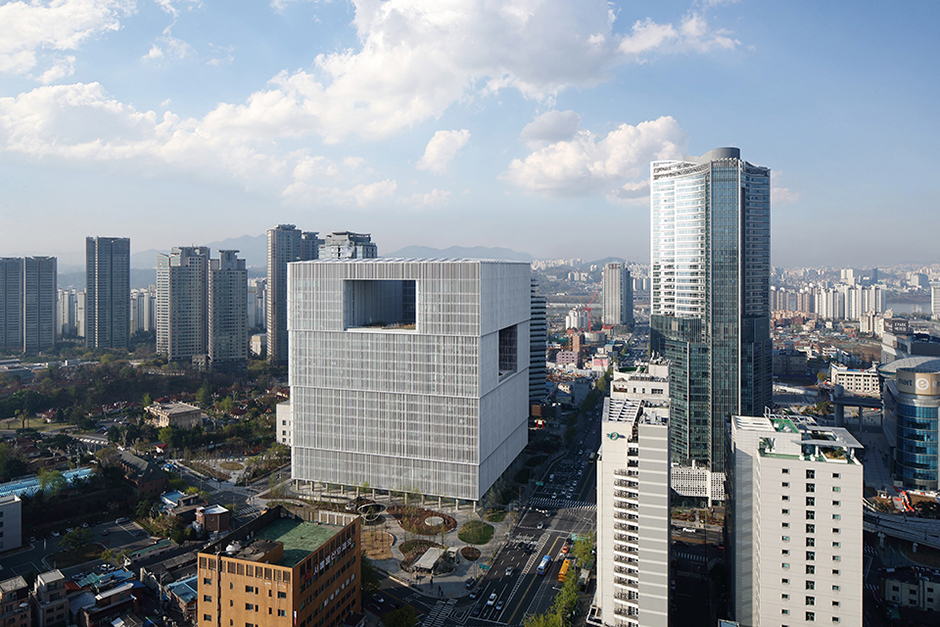
Amorepacific Museum of Art (아모레퍼시픽미술관)
5.6Km 2024-12-31
100 Hangang-daero, Yongsan-gu, Seoul
Amorepacific Museum of Art, located in Yongsan-gu, Seoul, was originally a museum exhibiting artworks collected by the late Seo Seong-hwan, the founder of Amorepacific, but later changed its name to Amorepacific Museum of Art, or APMA, in 2009 and has since been operating as an art exhibition hall. The mission upon its foundation was seeking to be "a space where beauty in the midst of daily lives is discovered" and communicating with the public. In accordance with this objective, the museum collects, researches, and exhibits Korean ancient art and both Korean and international contemporary art while, also, aiding researchers, scholars, and young artists. The underground exhibition hall hosts diverse exhibits encompassing ancient art, contemporary art, and Korean art. The 1st floor of the "Atrium," an enormous space that continues from the 1st to 3rd floors, features the museum lobby, a museum shop, an exhibition space called "APMA Cabinet" and apLAP, which is a library of art exhibition brochures from around the world. The art museum is located on the 1st floor of the new Amorepacific headquarters building, a famous work of architectural beauty of Yongsan designed after white porcelain.
Hanshin Medipia Health Care ((사) 정해복지부설 한신메디피아의원)
5.6Km 2025-10-23
(3rd Floor), 94 Jamwon-ro, Seocho-gu, Seoul
Hanshin Medipia Health Care was established in the 1980s and boasts over 40 years of experience and tradition in health screening. With its extensive experience and expertise, we promise you to become a trusted healthcare partner.
-More specialized and segmented with 3 Zones and 7 Centers.
3 Zones: Premium Zone, Comprehensive Health Checkup Zone, and General Health Checkup Zone, capable of examining approximately 1,000 persons per day.
7 Centers: Ultrasound Center, Radiology Center, Diagnostic Medicine Center, Endoscopy Center, Women's Health Checkup Center, Cancer Diagnostics Imaging Center, and CRM/IT/AI Center
CU - National Museum of Korea Branch [Tax Refund Shop] (cu중앙박물관점)
5.7Km 2024-06-26
137, Seobinggo-ro, Yongsan-gu, Seoul
-
Rebom Hospital (리봄한방병원)
5.7Km 2025-10-23
(2nd-4th Floors), 7 Hakdong-ro 50-gil, Gangnam-gu, Seoul
Rebom Hospital is a spine and joint hospital characterized by collaboration between western and Korean medicine. We provide treatment for spine and joint pain focusing on chiropractic and spinal joint care, along with precise examination through equipment such as X-rays and the exBody 3D body shape measurement system. Our main practice areas include neck and back discs, car accident aftereffects, herbal medicine for diet control, and x_height growth stimulation. We specialize in prescribing premium clean herbal medicines as well as body shape correction for conditions such as pelvic deformity, text neck and curved back, scoliosis, temporomandibular disorders (TMD).
Our international support team is available in multiple languages, including English, French, Chinese, Arabic, and more, so that international patients feel comfortable to visit us.
Topten - Starcity Mall Branch [Tax Refund Shop] (탑텐 건대스타시티)
5.7Km 2024-04-18
5F, 92, Neungdong-ro, Gwangjin-gu, Seoul
-
![Kumkang Shoes - Lotte STARCITY Branch [Tax Refund Shop] (KK롯데건대(금강 금강제화))](http://tong.visitkorea.or.kr/cms/resource/14/2878814_image2_1.jpg)
Kumkang Shoes - Lotte STARCITY Branch [Tax Refund Shop] (KK롯데건대(금강 금강제화))
5.7Km 2024-04-22
5, Seolleung-ro 162-gil, Gangnam-gu, Seoul
-
Uniqlo - Konkuk Univ. Branch [Tax Refund Shop] (유니클로 건대)
5.7Km 2024-04-18
92, Neungdong-ro, Gwangjin-gu, Seoul
-
 English
 한국어
한국어 日本語
日本語 中文(简体)
 Deutsch
 Français
 Español
 Русский


