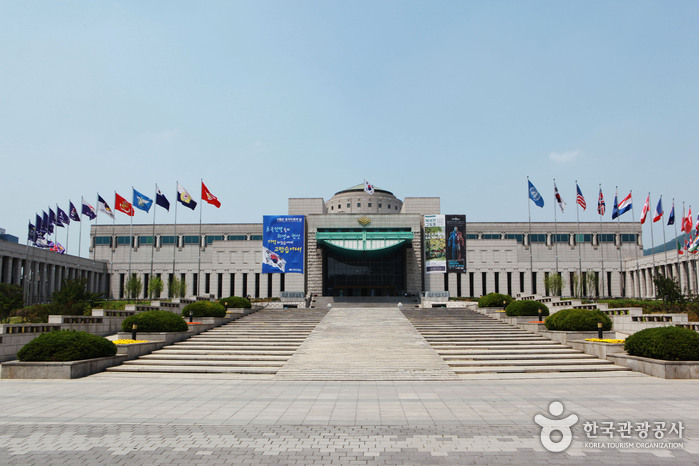
The War Memorial of Korea (전쟁기념관)
7.1Km 2022-12-29
29, Itaewon-ro, Yongsan-gu, Seoul
+82-2-709-3144
The War Memorial of Korea, located in Yongsan-gu, Seoul, exhibits and preserves materials related to the Korean War and serves as a national moral educational venue. It was established on June 10, 1994 by the War Memorial Service Korea Society to commemorate the noble sacrifice of patriotic martyrs. The museum houses approximately 33,000 artifacts with about 10,000 on display at indoor and outdoor exhibitions. There are six separate indoor halls, including Expeditionary Forces Room, Patriotic Memorial Room, War History Room, 6·25 Korean War Room, Development Hall and Large Machinery Room. The outdoor exhibition showcases large-sized weapons. Visitors of all ages from children to adults can also participate in 20 various educational programs and diverse cultural events such as military music and honor guard events, drawing contest, cultural event and more. The character of War Memorial of Korea is ‘Mudori’ featuring a helmet symbolizing the protection of the nation and a bay leaf meaning peace.
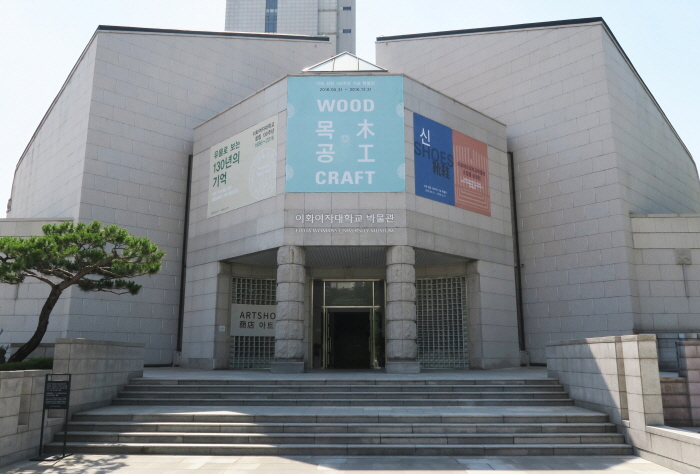
Ewha Womans University Museum (이화여자대학교박물관)
7.1Km 2022-09-14
52, Ewhayeodae-gil, Seodaemun-gu, Seoul
+82-2-3277-3152
The Ewha Womans University Museum was established in 1935 with the goal of preserving the cultural heritage of Korea. Originally, items related to folk art, traditional woodwork, and pottery were put on display in the hall of the main university to keep them from being confiscated during the Japanese occupation. This later led to the opening of the museum to display and store the growing collection.
Regular exhibitions of the museum’s collection have been taking place annually from 1972. Since 1996, the museum also held special exhibitions that focus on other themes related to cultural heritage. Additional small-scale exhibitions are also held frequently to promote Korea's traditional culture and art.
A ceramics research facility as well as a more traditional museum, a large portion of the museum’s efforts is focused on the research and excavation of kilns. To this aim, excavation teams from the museum have traveled to various parts of the country to conduct studies on historic sites and assess the value of artifacts. Through the publication of books and reports on its discoveries, the museum has contributed to raising knowledge and awareness of Korean cultural heritage in academia and among the public.

Ewha Welcome Center (이화웰컴센터)
7.1Km 2022-09-13
52, Ewhayeodae-gil, Seodaemun-gu, Seoul
+82-2-3277-3277
Ewha Welcome Center opened in 2013 as the first promotional center and visitor center of its kind on a university campus in Korea, comprised of an information desk, exhibition lounge, and gift shop. The information desk offers useful information to help visitors get the most out of their Ewha campus experience. The exhibition lounge introduces the history, traditions, and vision of the present-day and future of the university year-round. Visitors can purchase university gear at the gift shop. Furthermore, foreign visitors can take part in a range of campus tour programs in English and Chinese for an enriching experience.
Seoul Hyochang Park (서울 효창공원)
7.1Km 2024-07-09
177-18 Hyochangwon-ro, Yongsan-gu, Seoul
+82-2-2199-7608
Hyochang Park covers 122,245 square meters spanning across Hyochang-dong and Cheongpa 2-dong. It is a historic landmark that once contained several royal tombs, and was known at that time as Hyochangwon. The cemeteries that were originally located in Hyochangwon belonged to Crown Prince Munhyo, King Jeongjo’s first son who died at the age of five; Royal Noble Consort Uibin of the Seong Clan, King Jeongjo’s royal concubine and Crown Prince Munhyo’s mother; Royal Noble Consort Sugui of the Park Clan, King Sunjo’s royal concubine; and her daughter Princess Yeongon. The royal tombs were moved to Seooreung Tombs in the waning months of the Japanese colonial period. The Japanese empire began the development of Hyochangwon into a park in 1924, and the Japanese governor-general officially assigned the site as a park in 1940.
Presently, several of Korea’s greatest leaders are buried in Hyochang Park. The remains mostly belong to independence activists including Yoon Bong-gil, Lee Bong-chang, and Baek Jeong-gi, whose graves are collectively known as Samuisa Tomb. A statue of Lee Bong-chang has been built in the graveyard. Among the other patriotic martyrs who are interred in the park are Kim Gu and some of the key figures of the provisional government such as Lee Dong-nyeong, Cha I-seok, and Cho Seong-hwan. An ancestral shrine named Uiyeolsa has been built along the main gate and holds the portraits of the deceased independence activists.
![Himart - Sangbong Branch [Tax Refund Shop] (하이마트 상봉점)](http://tong.visitkorea.or.kr/cms/resource/52/2889952_image2_1.jpg)
Himart - Sangbong Branch [Tax Refund Shop] (하이마트 상봉점)
7.2Km 2024-04-18
399, Mangu-ro, Jungnang-gu, Seoul
-
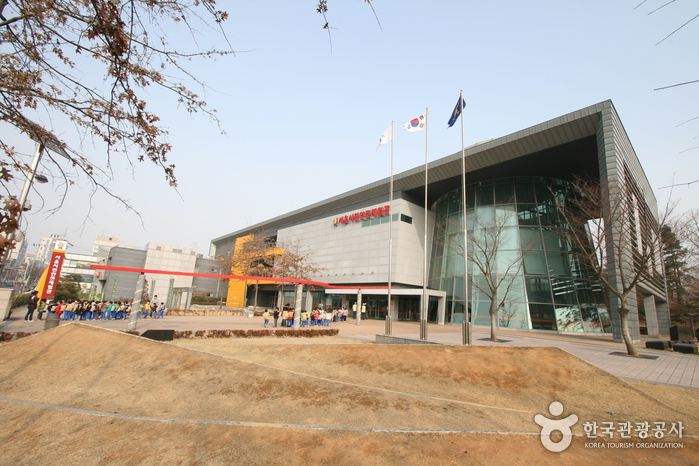
Gwangnaru Safety Experience Center (광나루안전체험관)
7.2Km 2025-03-29
238, Neungdong-ro, Gwangjin-gu, Seoul
+82-2-2049-4061
Gwangnaru Safety Experience Center was founded in 1999 after two fire accidents in which many children lost their lives. These tragedies emphasized the necessity of establishing a disaster training center for common citizens.
Gwangnaru Safety Experience Center is a three-story building with one basement floor, covering an area of more than 5,000 m². The basement floor includes a small theater. The first floor is set up for natural disaster training and consists of an orientation hall, storm simulation training room, earthquake simulation room, computer tests on fire safety knowledge and others. The second floor is a place for artificial catastrophe training. It consists of a smoke escape training room, fire extinguisher training room, first-aid (CPR) training room and practice place for calling 119. The third floor is used for rescue training and consists of a rescue training room, screening room, training for professionals and video examples of the five biggest disasters that have occurred in Seoul. Overall there are about 20 training areas established, so citizens can experience the imitation of a disaster by themselves and learn easily and in an interesting way how to cope with a disaster.
Seodaemun Museum of Natural History (서대문자연사박물관)
7.2Km 2021-07-02
51, Yeonhui-ro 32-gil, Seodaemun-gu, Seoul
+82-2-330-8899
Nestled at the foothills of Ansan Mountain, a natural resting area in the city, Seodaemun Museum of Natural History is the first natural history museum in the nation to be established by a government agency. Opened on July 10, 2003, the museum offers various opportunities to experience and learn about the environment. It also provides the chance to interact with animals and plants, teaching the value of life.
River City Water Ski Resort (리버시티수상스키장)
7.2Km 2025-10-23
37-53 Apgujeong-ro 11-gil, Gangnam-gu, Seoul, Jamwon District 1 in Hangang Park
In 'I Live Alone', it is none other than the Hangang River where SHINee's Key and Minho enjoyed water skiing and 'Pangpang' boat. Necessary equipment can be rented, and water skiing and wakeboarding lessons are also offered, so even beginners can visit without any hesitation. Above all, the most attractive thing is that you can enjoy water sports in downtown Seoul without having to go far. There are shower rooms and changing rooms, as well as a Ramyeon making machine. There is no better delicacy than eating freshly boiled Ramyeon while drying your wet hair after playing in the water.
Korea Institute of Radiological & Medical Sciences, Korea Cancer Center Hospital (한국원자력의학원 원자력병원)
7.2Km 2025-11-28
75 Nowon-ro, Nowon-gu, Seoul
KCCH (Korea Cancer Center Hospital) is a leading institution specializing in cancer diagnosis, treatment, and research using radiation. It has established an efficient collaborative care system and an integrated multidisciplinary approach to treatment. In addition to cancer care, the hospital operates a hospice palliative care center, offering holistic care to patients. As a government-funded organization, it actively conducts molecular cancer research and studies on the effects of radiation on the human body. With the introduction of PET/MRI diagnostics, KCCH develops more precise treatment plans and leads international clinical research, continuously improving cancer treatment outcomes through advanced research.
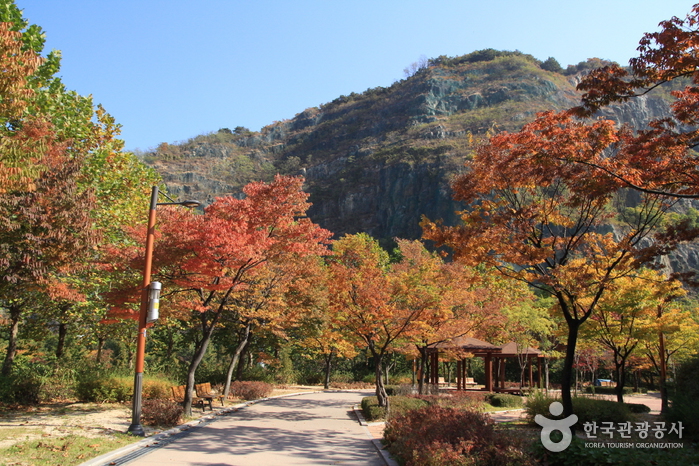
Yongmasan Mountain (용마산)
7.2Km 2021-06-18
53, Yongmasan-ro 62-gil, Jungnang-gu, Seoul
+82-2-2094-2344
With an altitude of 348 meters, Yongmasan Mountain is the highest peak of Achasan Mountain. The mountain stretches through the ridges of Manguri Park and Junggok-dong, with trails connecting to Achasan Mountain Fortress and the back gate of Children’s Grand Park. Nearby parks include Yongmapokpo Park and Yongmasan Sagajeong Park.
 English
 한국어
한국어 日本語
日本語 中文(简体)
 Deutsch
 Français
 Español
 Русский


