![Runners Club - Ewha Womans Univ. Branch [Tax Refund Shop] (러너스클럽 이대)](http://tong.visitkorea.or.kr/cms/resource/12/2889512_image2_1.jpg)
Runners Club - Ewha Womans Univ. Branch [Tax Refund Shop] (러너스클럽 이대)
8.6Km 2024-04-23
#103, 160, Sinchon-ro, Mapo-gu, Seoul
-

Sogang University (서강대학교)
8.6Km 2023-07-07
35, Baekbeom-ro, Mapo-gu, Seoul
+82-2-705-8114
Sogang University is a private, coeducational, Jesuit university located in central Seoul. Campus life at Sogang University is enhanced by student clubs as well as technological advancement. Furthermore, the proximity to other leading universities (Yonsei University and Ewha Woman's University) contributes to the intellectual and social vitality of student life at Sogang University.
Seodaemun Prison History Museum (서대문형무소역사관)
8.6Km 2024-12-02
251 Tongil-ro, Seodaemun-gu, Seoul
Seodaemun Prison was built under the Japanese administration to imprison independence movement activists. It first opened on October 21, 1908 under the name Gyeongseong Prison. Eventually, so many activists were imprisoned that the building had to be expanded. At that time, the name changed to Seodaemun Prison on September 3, 1912. Eighty years later, the prison was turned into Seodaemun Independence Park on August 15, 1992 to commemorate the Korean patriots who were tortured in prison, giving their lives for freedom. Of the many buildings, only seven were preserved for their historical significance, among which three prison buildings and the execution site were designated as a Historic Site. In 1998, the park underwent another transformation into today's Seodaemun Prison History Hall to educate the public on the importance of Korea's independence and the sacrifices of those who fought to achieve it.
Dongnimmun Gate (독립문)
8.6Km 2022-12-15
251, Tongil-ro, Seodaemun-gu, Seoul
Dongnimmun stands at the location originally known as Yeongeun, where envoys were once treated. When a Chinese envoy visited, the King would go out through this door to greet. In 1898, to announce the independence from Japan, Dongnimun was constructed with the fund collected by the citizens. The traces of the past still remain on Dongnimmun with two pillars in front of Dongnimmun being the remains of Yeongeunmun.
The Arc de Triomphe in France can be recalled in comparison to Dongnimmun. Dongnimmun was built using granite with a passageway x_height of 14.28 meters. On the top it is written ‘Dongnimmun’ in Korean with the national flag drawn on each side. On the inner-left side there are stone stairs leading to the attic. The national flower Mugunghwa are planted around Dongnimmun. Now it is surrounded by roads and it is eye-catching to view when passing by.
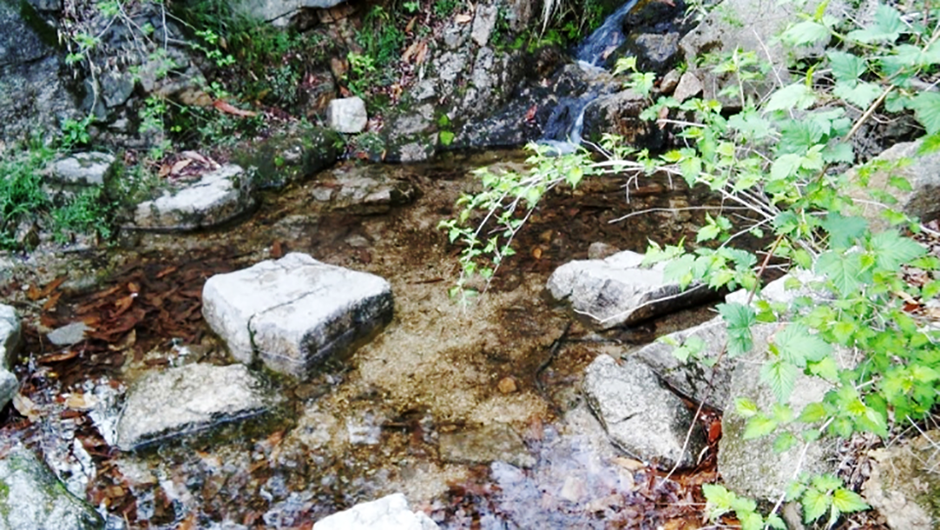
Suseongdonggyegok Valley (수성동계곡)
8.7Km 2023-08-17
185-3, Ogin-dong, Jongno-gu, Seoul 서울특별시 종로구 옥인동
Suseong-dong Valley's stream runs down from Inwangsan Mountain and joins Cheonggyecheon Stream, and it is said that the name of the village was called Suseong-dong during the Joseon dynasty due to the loud and clear sound of the flowing water. It appears in the painting "Jangdong Palgyeongcheop," which is Jangdong Eight Scenic Views, that depicts the eight scenic views of Bugaksan Mountain and Inwangsan Mountain as well as in other historical books of the Joseon dynasty as a place of scenic beauty. The valley was so famous for its beauty, that Prince Anpyeong of the Joseon dynasty built his house "Bihaedang" to fully enjoy the view, and the valley and its stone bridge were designated as a cultural property of Seoul in 2010.
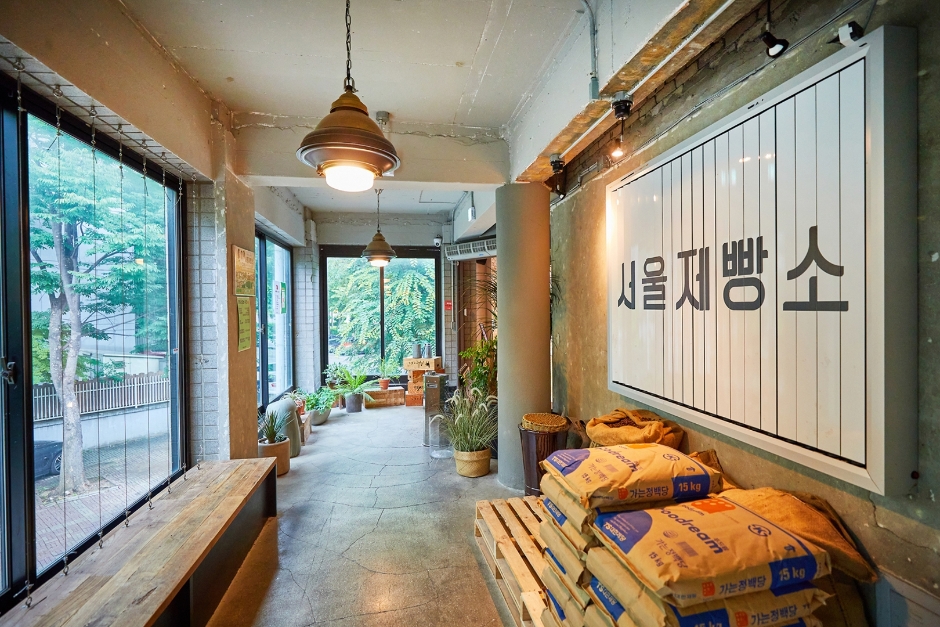
Seoul Bakery (서울제빵소 올림픽본점)
8.7Km 2024-03-20
1178 Yangjae-daero, Songpa-gu, Seoul
This bakery cafe is located on the second floor of a commercial wing attached to the Olympic Village Apartments, located across from Olympic Park’s Rose Plaza. The spacious cafe features naturally fermented bread made with organic flour and seats looking out the window. The interior is modern and open, with plenty of seats for long stays. Naturally fermented bread here includes Hongguk rice bread, salt bread, and cream cheese and fig bread. Bread is baked from 08:00 to midday. Visitors can find a timetable for the different kinds of bread served in this cafe in order to make plans in advance to get freshly-baked bread.
Jihwaja (지화자)
8.7Km 2024-03-18
125 Jahamun-ro, Jongno-gu, Seoul
+82-2-2269-5834
Jihwaja is a traditional Korean restaurant operated by a successor of Joseon dynasty royal dishes. Their manchan course (full course) includes menus served at royal banquets such as gungjung manchan (royal course), Jineo-byul manchan (deluxe royal degustation course), and janggeum manchan (daejanggeum degustation course) courses. The janggeum course reconstructs dishes from the drama "Dae Jang Geum." For the Jeongchan course (Set menu), they offer so galbi sura (grilled beef ribs course), jeonbok cho sura (braised abalones in soy sauce course), so galbi jjim sura (braised beef short ribs course), and haemul sinseollo sura (seafood hot pot course). Additionally, they serve milk porridge, meat and vegetable skewers, mandu, royal hot pot, and grilled marinated beef.
![Uireung Royal Tomb [UNESCO World Heritage] (서울 의릉(경종, 선의왕후) [유네스코 세계문화유산])](http://tong.visitkorea.or.kr/cms/resource/80/2690680_image2_1.jpg)
Uireung Royal Tomb [UNESCO World Heritage] (서울 의릉(경종, 선의왕후) [유네스코 세계문화유산])
8.7Km 2021-06-03
146-20, Hwarang-ro 32-gil, Seongbuk-gu, Seoul
+82-2-964-0579
Uireung is the royal tomb of King Gyeongjong (reign 1720-1724), the 20th ruler of the Joseon dynasty, and his second wife, Queen Seonui.
King Gyeongjong was the first son of King Sukjong and Janghuibin, who was one of King Sukjong’s concubines. King Gyeongjong, who was born weak and anemic, died four years after becoming the king, without any great political achievements. Uireung tombs differ from the other royal double tombs in that they are not placed side-by-side. Instead, according to geomantic theory, one tomb has been placed directly behind the other one. The arrangement also shows that when making tombs, Korean ancestors did their best to protect the natural environment. Another feature of Uireung Royal Tomb is the stone fence raised using twelve stone posts. Each post has a letter inscribed, representing one of the twelve sibijisin gods.
The Catholic University of Korea, Yeouido St. Mary's Hospital (가톨릭대학교 여의도성모병원)
8.7Km 2025-10-23
(Yeouido-dong), 10 63-ro, Yeongdeungpo-gu, Seoul
The Catholic University of Korea, Yeouido St. Mary's Hospital, established in 1936, is a hospital affiliated with a medical school and has a rich history of advancing the country's medical field through exceptional medical staff and pioneering research.
The hospital offers a convenient fast-track service for swift diagnosis and treatment, ranging from complex cancer care to minor conditions. As the first in Korea to open a dedicated lymphoma center, we have specialized expertise in treating various cancers, including lymphoma.
Our use of da Vinci robotic surgery allows for precise, minimally invasive procedures for complex conditions such as uterine fibroids, rectal cancer, prostate cancer, and thyroid cancer, promoting faster recovery. The hospital's one-stop service for breast and thyroid nodules ensures rapid diagnosis and treatment planning, completing biopsies within a single day.
At the Catholic University of Korea, Yeouido St. Mary's Hospital, we remain committed to providing top-tier medical services and advancing medical research while upholding the highest standards of bioethics.
Korea Furniture Museum (한국가구박물관)
8.8Km 2025-10-24
121 Daesagwan-ro, Seongbuk-gu, Seoul
The Korea Furniture Museum, located on a hill in Seongbuk-dong, Seoul, is a special museum that displays items related to Korea's traditional living culture. The museum exhibits wooden furniture made in the late Joseon dynasty by material (persimmon tree, maple tree, paulownia tree, zelkova tree, pine tree, papers, etc.), by the type of space (men’s quarters, women’s quarters, kitchen, etc.), and by regional characteristics. It also exhibits interior decorations, flower walls, chimneys, and yards, as well as ten traditional Korean houses.
This museum operates through a guided tour (maximum of 20 people per group) only, suitable for showing Korea's housing culture that harmonizes furniture and nature. The old household items, “furniture,” are displayed in rooms outside glass storage boxes, allowing visitors to experience a beautiful traditional culture.
Since it was selected as the official luncheon venue for the spouses of leaders of 20 countries at the 2010 G20 Seoul Summit, there has been a steady stream of state guests and worldwide celebrities, including Chinese President Xi Jinping and his wife, the German President, the Prime Minister of Hungary, the Prime Minister of Singapore, the King and Queen of Belgium, the King of Sweden, the head of the IMF, and movie stars Brad Pitt, and Victoria Beckham.
In addition, it was selected as the "most beautiful museum in Seoul” by CNN in 2011. The museum also served as an interview location for BTS members, who are receiving global attention. As such, it is attracting attention as a representative tourist destination in Seoul and a cultural space preferred by government ministries and companies. Tours require reservations, which can be made through the website.
 English
 한국어
한국어 日本語
日本語 中文(简体)
 Deutsch
 Français
 Español
 Русский


