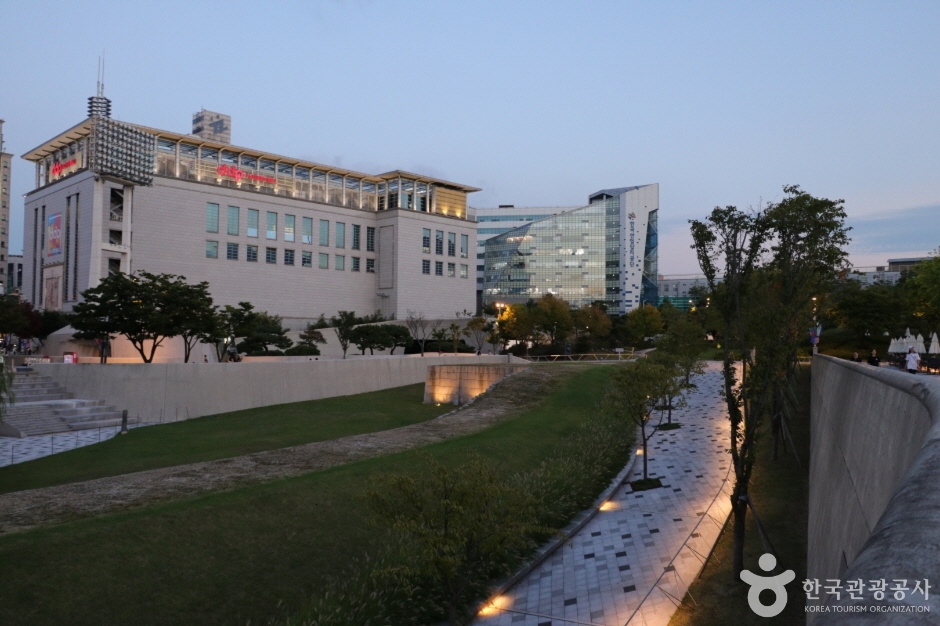
Dongdaemun History & Culture Park (동대문역사문화공원)
4.7Km 2024-11-27
281 Eulji-ro, Jung-gu, Seoul
Dongdaemun History & Culture Park is a park established on the former site of the Dongdaemun Stadium. It serves as a thematic park showcasing the history and culture of Seoul, while also providing a space to experience modern design and culture. During the park's development in 2008, numerous artifacts from the Joseon dynasty, including The Two Floodgates, the Chiseong Castle, Military Training Agency, and over 1,000 relics from the Joseon era, were excavated. Alongside the park, there is the Dongdaemun Design Plaza (DDP) and the Relic area.
![New Balance - Daehangno Branch [Tax Refund Shop] (뉴발란스 대학로점)](http://tong.visitkorea.or.kr/cms/resource/82/2878182_image2_1.jpg)
New Balance - Daehangno Branch [Tax Refund Shop] (뉴발란스 대학로점)
4.7Km 2024-04-16
133-2, Daehak-ro, Jongno-gu, Seoul
-
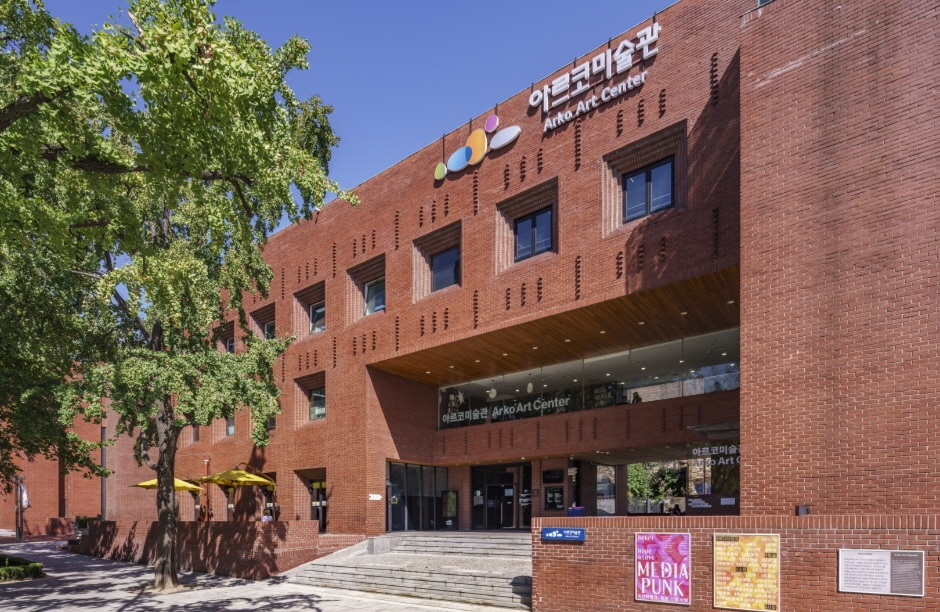
ARKO Art Center (아르코미술관)
4.7Km 2025-06-05
3, Dongsung-gil, Jongno-gu, Seoul
+82-2-760-4850
ARKO Art Center was founded in 1974 as Misulhoegwan in a building of former Deoksu Hospital in Gwanhun-dong, Jongno-gu to offer much-needed exhibition space for artists and arts groups. In 1979, Misulhoegwan moved to its present building, designed by preeminent Korean architect Kim Swoo-geun (1931-1986) and located in Marronnier Park, the former site of Seoul National University. The two neighboring brick buildings accommodating ARKO Art Center and ARKO Arts Theater are the major landmarks of the district of Daehakro.
As more public and private museums and commercial galleries came into the art scene in the 1990s, Misulhoegwan shifted to curating and presenting its own exhibitions. Renamed as Marronnier Art Center in 2002, ARKO Art Center assumed a full-fledged art museum system and played an increasingly prominent role as a public arts organization leading the contemporary art paradigm. When The Korea Culture and Arts Foundation was reborn as Arts Council Korea, Marronnier Art Center became ARKO Art Center named after the abbreviation for Arts Council Korea in 2005.
ARKO Art Center is committed to working as a platform where research, production, exhibitions and the exchange of creative activities grow and develop in connection with one another in addition to having a diversity of programs including thematic exhibitions addressing social agenda and public programs widely promoting various discourses in art.
![Saera - Daehangno Branch [Tax Refund Shop] (세라제화 대학로)](http://tong.visitkorea.or.kr/cms/resource/85/2878185_image2_1.jpg)
Saera - Daehangno Branch [Tax Refund Shop] (세라제화 대학로)
4.7Km 2024-04-19
123-1, Daehak-ro, Jongno-gu, Seoul
-
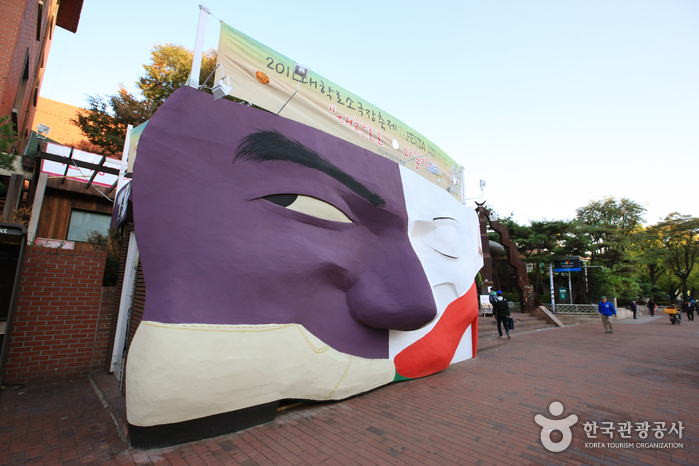
Daehangno (University Street) (대학로)
4.7Km 2021-03-25
104, Daehak-ro, Jongno-gu, Seoul
+82-2-2148-1114
Daehangno is an artistic neighborhood that stretches 1.1 kilometers from Jongno 5-ga Intersection to Hyehwa-dong Rotary. The area is filled with culture and performing arts facilities, with the center of all this being Marronnier Park. Visitors can find performances taking play every day at the many theaters large and small, as well as restaurants serving a range of cuisines. The area is especially active on weekends and during the street festival period.
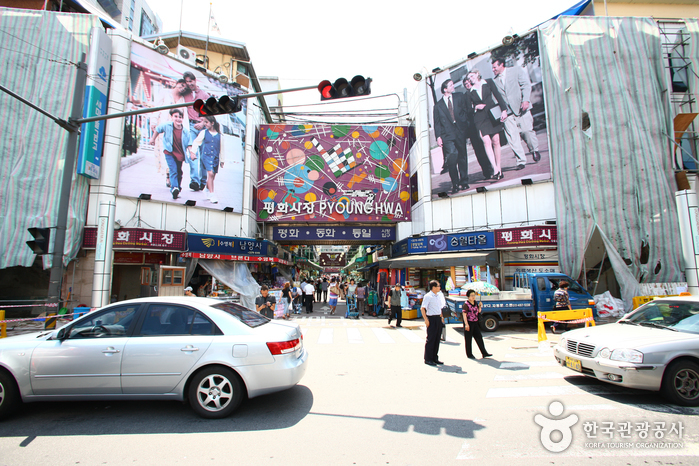
Pyounghwa (Pyeonghwa) Fashion Town (서울 평화시장)
4.7Km 2025-01-06
274, Cheonggyecheon-ro, Jung-gu, Seoul
+82-2-2265-3531~3
The Pyounghwa Fashion Town market in Dongdaemun has been selling fashion clothing and accessories for over 50 years ever since the end of the Korean War. It was here that in 1953 North Korean refugees started selling clothes made from US army uniforms. Their market was then named Pyounghwa, which means peace, in the hope that no other wars would be fought on Korean soil. The Pyounghwa Fashion Town was therefore the beginning of the 30,000 stores that now make up Dongdaemun Fashion Town, which is seen as one of the global centers of the fashion industry.
Spread over a large area, this historical fashion market is divided into several districts, the ‘Gu Pyounghwa Fashion Town’ is the oldest, and there is also the ‘Shin Pyounghwa Fashion Town’, ‘Dong Pyounghwa Fashion Town’, and ‘Cheong Pyounghwa Fashion Town’.
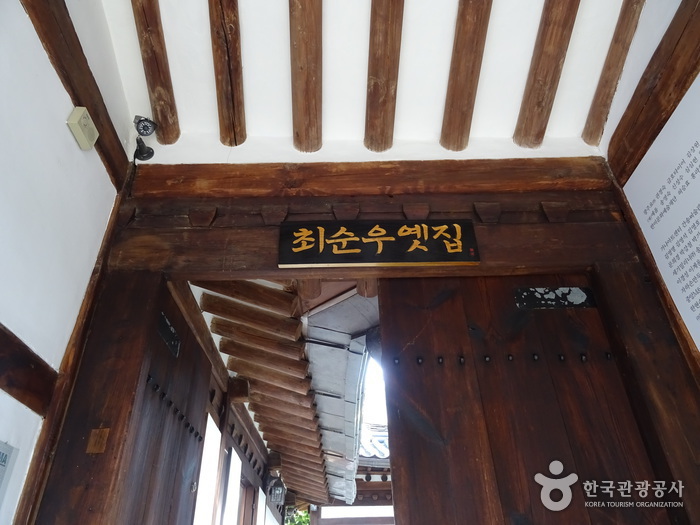
Choi Sunu House (최순우 옛집)
4.7Km 2021-12-21
9, Seongbuk-ro 15-gil, Seongbuk-gu, Seoul
+82-2-3675-3401
The Choi Sunu House is the old residence of Hyegok Choi Sunu (1916-1984), who lived in this house from 1976 until the day he passed away. The house is designated as Korea’s Registered Cultural Property. Choi Sunu was a leading art historian who served as the director of the National Museum of Korea. He devoted his life to rediscovering the beauty of Korean art and made many academic accomplishments in the areas of Korean ceramics, traditional woodcraft, and the history of painting.
The house has been open to the public as the Hyegok Choi Sunu Memorial Hall since 2004. The memorial hall displays Choi Sunu’s relics as a permanent exhibition and holds special exhibitions in the fall as well as cultural programs every spring and fall.
Seoul Mangusan Mountain (망우산(서울))
4.7Km 2021-02-10
San 69-1, Mangu-dong, Jungnang-gu, Seoul
+82-2-2094-2395
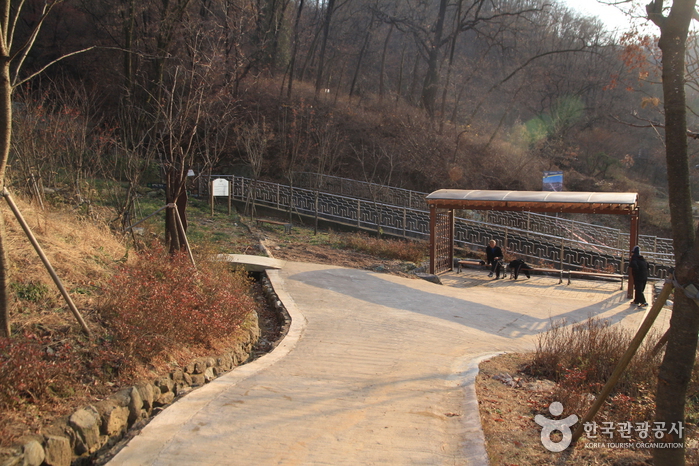
Mangusan Mountain at 281.7 meters above sea level spans across Mangu-dong and Myeonmok-dong of Seoul, and Guri-si of Gyeonggi-do. Located on the mountain is Mangu Cemetery, which was designated as a public cemetery in 1933. Since its designation, many popular people have been buried here including children’s literature author Bang Jeong-hwan (penname: Sopa), independence activists Oh Se-chang and Han Yong-un, and Ji Seok-young who pioneered the use of the smallpox vaccination in Korea and was also a Korean linguist. In addition, tombstones bearing chronological listings of seven popular poets and one educator were installed at the park, making the cemetery a venue for historical education. The park also has Sin Gyeong-jin Sindobi, a cultural asset designated as Seoul Tangible Cultural Property No. 95. It is a monument of Sin Gyeong-jin, an official scholar of the Joseon dynasty.
The park also has a 5.2-kilometer-long circular road named “The Thinking Path”. The name was selected through a public competition held in May 1998. Other facilities include the urban environment and nature observation road, a wooden gazebo, and a mineral spring. Thanks to the well managed trees and clean air, the park is visited by many citizens seeking a place to rest.
![Himart - Cheonggu Branch [Tax Refund Shop] (하이마트 청구점)](http://tong.visitkorea.or.kr/cms/resource/46/2889946_image2_1.jpg)
Himart - Cheonggu Branch [Tax Refund Shop] (하이마트 청구점)
4.7Km 2024-04-18
210, Dasan-ro, Jung-gu, Seoul
-

Seoul National University Hospital (서울대학교병원)
4.7Km 2025-10-23
101 Daehak-ro, Jongno-gu, Seoul
Seoul National University Hospital, a national central hospital that has led Korean medicine for over 130 years, is a top-tier hospital equipped with world-class medical professionals and cutting-edge systems. For 25 consecutive years, it has ranked first in brand power in the hospital sector. The hospital is renowned for its cancer research, the most comprehensive pediatric care in the country, and treatments for rare and intractable diseases. Through patient-centered, personalized services, it has established itself as a trusted healthcare institution.
 English
 한국어
한국어 日本語
日本語 中文(简体)
 Deutsch
 Français
 Español
 Русский


