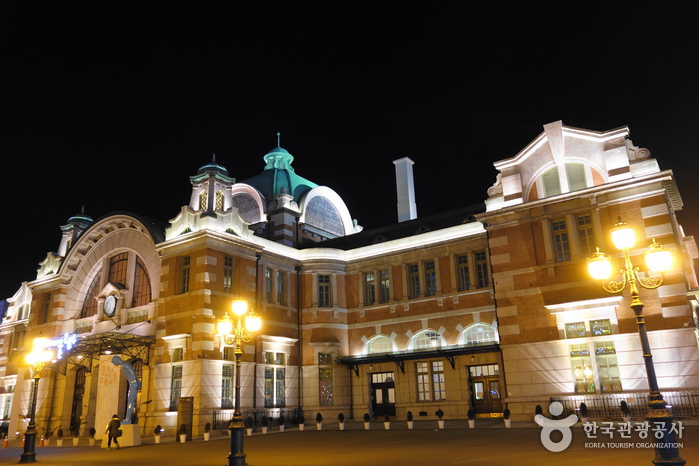
Culture Station Seoul 284 (문화역 서울 284)
9.2Km 2025-10-23
1 Tongil-ro, Jung-gu, Seoul
Culture Station Seoul 284 opened in 2011 by restoring the old Seoul Station. The complex holds various programs including exhibitions, performances, cultural events and workshops. It holds over 100 years of history with Namdaemun Station being the original name of the station in 1900 and changing to Gyeongseong Station, Seoul Station, and now Culture Station Seoul 284. The look of 1925 Gyeongseong Station offers visitors a flashback to the past, providing a fun and special experience.
◎ Travel information to meet Hallyu’s charm
This is where Mok-ha (played by Park Eun-bin) waited for Ki-ho (played by Chae Jong-hyeop) with flowers in the TV series "Castaway Diva." As the restored historic Seoul Station, it also appeared in "Reply 1994" as the location where Samcheonpo (played by Kim Sung Kyun) first arrived in Seoul.
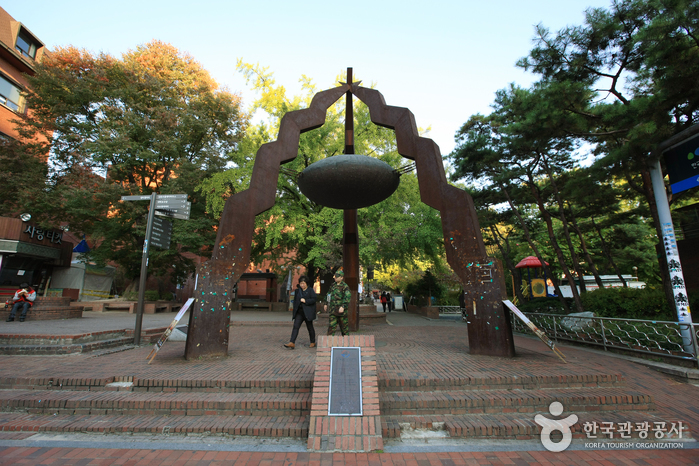
Marronnier Park (마로니에공원)
9.2Km 2021-07-14
104, Daehak-ro, Jongno-gu, Seoul
+82-2-2148-4158
Marronnier Park was given its name due to the marronnier trees, or horse chestnut trees, growing within the area. The location where Seoul National University's College of Liberal Arts & Science and School of Law once stood, it is now a park dedicated to culture and arts open to the public. In addition to a variety of outdoor performances that take place throughout the area, exhibitions and cultural centers create a romantic atmosphere unique to the park.

Olive Young - Jongno Branch [Tax Refund Shop] (올리브영 종로점)
9.2Km 2024-06-27
1F, 78, Jong-ro, Jongno-gu, Seoul
-
![Zara - Lotte Seoul Station Branch [Tax Refund Shop] (자라 롯데 서울역점)](http://tong.visitkorea.or.kr/cms/resource/25/2878425_image2_1.jpg)
Zara - Lotte Seoul Station Branch [Tax Refund Shop] (자라 롯데 서울역점)
9.2Km 2024-04-22
378, Cheongpa-ro, Yongsan-gu, Seoul
-
![Kumkang Land Rover - Jongno Branch [Tax Refund Shop] (CL종로지점(금강 랜드로바))](http://tong.visitkorea.or.kr/cms/resource/95/3313995_image2_1.jpg)
Kumkang Land Rover - Jongno Branch [Tax Refund Shop] (CL종로지점(금강 랜드로바))
9.2Km 2024-06-27
81, Jongro, Jongno-gu, Seoul
-
Seoul Hyochang Park (서울 효창공원)
9.2Km 2024-07-09
177-18 Hyochangwon-ro, Yongsan-gu, Seoul
+82-2-2199-7608
Hyochang Park covers 122,245 square meters spanning across Hyochang-dong and Cheongpa 2-dong. It is a historic landmark that once contained several royal tombs, and was known at that time as Hyochangwon. The cemeteries that were originally located in Hyochangwon belonged to Crown Prince Munhyo, King Jeongjo’s first son who died at the age of five; Royal Noble Consort Uibin of the Seong Clan, King Jeongjo’s royal concubine and Crown Prince Munhyo’s mother; Royal Noble Consort Sugui of the Park Clan, King Sunjo’s royal concubine; and her daughter Princess Yeongon. The royal tombs were moved to Seooreung Tombs in the waning months of the Japanese colonial period. The Japanese empire began the development of Hyochangwon into a park in 1924, and the Japanese governor-general officially assigned the site as a park in 1940.
Presently, several of Korea’s greatest leaders are buried in Hyochang Park. The remains mostly belong to independence activists including Yoon Bong-gil, Lee Bong-chang, and Baek Jeong-gi, whose graves are collectively known as Samuisa Tomb. A statue of Lee Bong-chang has been built in the graveyard. Among the other patriotic martyrs who are interred in the park are Kim Gu and some of the key figures of the provisional government such as Lee Dong-nyeong, Cha I-seok, and Cho Seong-hwan. An ancestral shrine named Uiyeolsa has been built along the main gate and holds the portraits of the deceased independence activists.
 English
 한국어
한국어 日本語
日本語 中文(简体)
 Deutsch
 Français
 Español
 Русский


