![ABC-Mart - Busan Gwangbok Branch [Tax Refund Shop] (ABC마트 ST부산광복)](http://tong.visitkorea.or.kr/cms/resource/36/2885836_image2_1.jpg)
ABC-Mart - Busan Gwangbok Branch [Tax Refund Shop] (ABC마트 ST부산광복)
11.3Km 2024-04-18
73-1, Gwangbok-ro, Jung-gu, Busan
-
![Artbox - Busan Gwangbok Branch (No. 2) [Tax Refund Shop] (아트박스 부산광복2호)](http://tong.visitkorea.or.kr/cms/resource/15/2885815_image2_1.jpg)
Artbox - Busan Gwangbok Branch (No. 2) [Tax Refund Shop] (아트박스 부산광복2호)
11.3Km 2024-04-22
ARTBOX, 73, Gwangbok-ro, Jung-gu, Busan
-
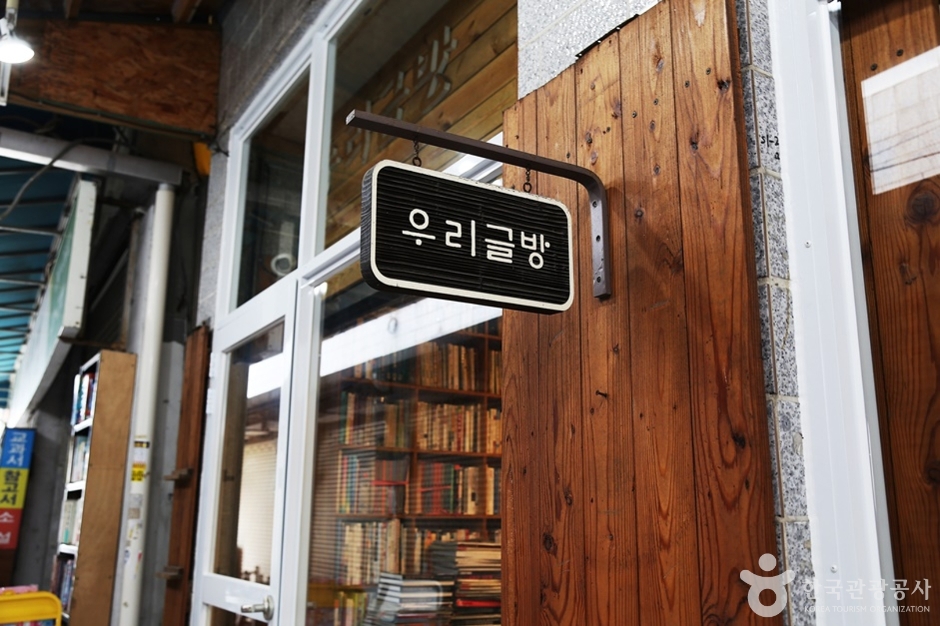
Urigeulbang (우리글방)
11.3Km 2024-02-13
63 Daecheong-ro, Jung-gu, Busan
Urigeulbang, a venerable bookstore located in the renowned Bosu-dong Book Street in Busan, is celebrated for its trade in used books. This bookstore doubles as a book café, allowing visitors the unique experience of reading from its extensive collection while enjoying a cup of coffee or other beverages, without the obligation to purchase a book. The owner, an enthusiastic collector of used books, has amassed a vast array of old and rare editions, making it a treasure trove for bibliophiles. Adjacent to Urigeulbang is the Bosu-dong Book Street Cultural Center, where visitors have the opportunity to delve into the rich history of this unique bookstore alley.
![Adidas - Gwangbok Branch [Tax Refund Shop] (아디다스 광복점)](http://tong.visitkorea.or.kr/cms/resource/37/2885837_image2_1.jpg)
Adidas - Gwangbok Branch [Tax Refund Shop] (아디다스 광복점)
11.3Km 2024-04-23
69-1, Gwangbok-ro, Jung-gu, Busan
-

National Maritime Museum (국립해양박물관)
11.3Km 2023-01-10
45 Haeyang-ro 301beon-gil, Yeongdo-gu, Busan
+82-51-309-1900
The National Maritime Museum is a comprehensive venue offering exhibitions on maritime culture, history, ocean life, science, and more. The exterior of the museum was designed to resemble a water droplet and is the third largest museum in Korea. The museum holds over 14,000 historic items and relics that have witnessed history and are relevant to the future of ocean life. These are on display in eight permanent exhibition halls, a special exhibition hall, and a children's exhibition hall. The museum also has a library, aquarium, grand auditorium, outdoor performance stage, and a 4D theatre for a multi-cultural experience.
![Onitsuka Tiger - Gwangbok Branch [Tax Refund Shop] (오니츠카타이거 광복)](http://tong.visitkorea.or.kr/cms/resource/27/2885827_image2_1.jpg)
Onitsuka Tiger - Gwangbok Branch [Tax Refund Shop] (오니츠카타이거 광복)
11.4Km 2024-04-18
65, Gwangbok-ro, Jung-gu, Busan
-
![New Era - Gwangbok Branch [Tax Refund Shop] (뉴에라 광복점)](http://tong.visitkorea.or.kr/cms/resource/81/2885881_image2_1.jpg)
New Era - Gwangbok Branch [Tax Refund Shop] (뉴에라 광복점)
11.4Km 2024-04-16
78-2, Gwangbok-ro, Jung-gu, Busan
-
![Fila - Busan Gwangbok Branch [Tax Refund Shop] (휠라 부산광복)](http://tong.visitkorea.or.kr/cms/resource/89/2885889_image2_1.jpg)
Fila - Busan Gwangbok Branch [Tax Refund Shop] (휠라 부산광복)
11.4Km 2024-04-23
76-2, Gwangbok-ro, Jung-gu, Busan
-
![ABC-Mart - Busan Gwangbok Branch [Tax Refund Shop] (ABC마트 GS부산광복)](http://tong.visitkorea.or.kr/cms/resource/23/2885823_image2_1.jpg)
ABC-Mart - Busan Gwangbok Branch [Tax Refund Shop] (ABC마트 GS부산광복)
11.4Km 2024-04-18
2, Gwangbokjungang-ro, Jung-gu, Busan
-
Gukje Market (국제시장)
11.4Km 2025-10-23
Area of Sinchang-ro 4-ga, Jung-gu, Busan
+82-51-245-7389
The current marketplace of Gukje Market first formed after the liberation of Korea from the Japanese administration when people gathered to trade overseas products left by the Japanese and brought in by Koreans who came back from abroad. Following the Korean War, refugees who fled to Busan set up stalls in order to make a living by selling smuggled or imported products, which developed into Gukje Market (gukje meaning "international" in Korean) of today. Gukje Market is one of Korea’s largest markets and a testament to Korea's modern history. The market is divided into two wings, and first-timers to the market are advised to be careful not to get lost in the maze-like alleys and halls.
 English
 한국어
한국어 日本語
日本語 中文(简体)
 Deutsch
 Français
 Español
 Русский


