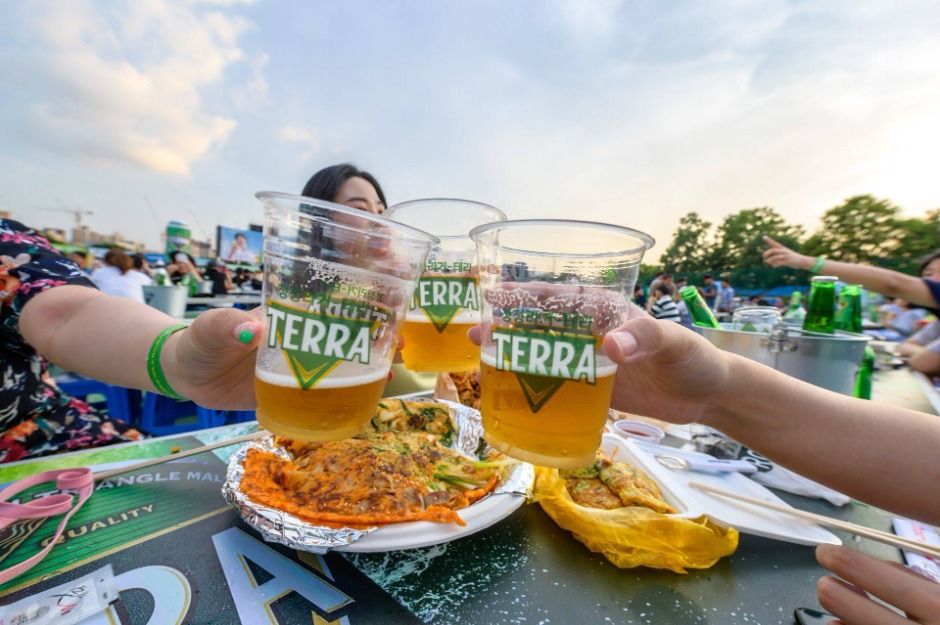
Festival de la bière de Jeonju (2022 전주 가맥축제)
14.2Km 2025-08-12
451, Girindae-ro, Deokjin-gu, Jeonju-si, Région Jeonbuk (전북특별자치도 전주시 덕진구 기린대로 451 전주종합경기장)
070-8870-6870
Seul festival en Corée où l’on peut déguster une bière produite le jour même à l’usine HiteJinro – site de Jeonju. Pendant trois jours, du 7 au 9 août, vivez des soirées d’été rafraîchissantes et exaltantes grâce à une bière fraîchement brassée et glacée, aux établissements Gamæk approuvés par les habitants de Jeonju, et à des spectacles hauts en couleur.
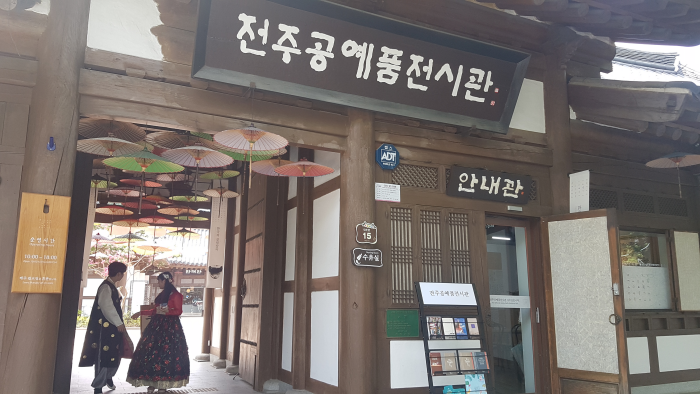
Centre d'exposition de l’artisanat traditionnel de Jeonju (전주공예품전시관 전주명품관)
14.2Km 2024-04-07
15, Taejo-ro, Wansan-gu, Jeonju-si, Région Jeonbuk
+82-63-282-8886
Le centre d’exposition de l’artisanat traditionnel de Jeonju permet non seulement aux visiteurs de découvrir la beauté de l’artisanat traditionnel coréen, mais aussi de créer leurs propres créations. Le centre abrite un hall d’exposition, un hall spécial et un hall pour les activités. C’est dans le hall des activités que les visiteurs peuvent créer leurs propres pièces : feuilles de papier de riz, poterie, meunuiserie, broderie etc. Par ailleurs, dans le magasin d’artisanat il est possible d’acheter des pièces faites par des professionnels.

Parc Deokjin (덕진공원)
14.2Km 2024-04-08
390, Gwon samdeuk-ro, Deokjin-gu, Jeonju-si, Région Jeonbuk
+82-63-239-2607
Le grand parc Deokjin (fondé en avril 1978) est un parc bien connu à Jeonju. Il est constitué d’un pavillon traditionnel, d’un marais d’iris, d’une cascade artificielle ou encore d’un pont en bois. Le parc est surtout connu pour ses fleurs de lotus, quand l’été arrive les nénuphars s’épanouissent complètement pour former un très beau paysage. A l’intérieur du parc, vous trouverez neuf sculptures commémoratives telles que ‘la sculpture pour les enfants’, ‘la sculpture Sin Seok-Jeong’, ‘la stèle de Kim Hae-kang’, ‘Jeon Bong-jun, Jang Gun-sang’, etc.
Jeongjogwan of the Royal Room / 왕의지밀 정조관
14.2Km 2025-08-13
5218-10, Chunhyang-ro, Wansan-gu, Jeonju-si, Région Jeonbuk
+82-63-284-1004
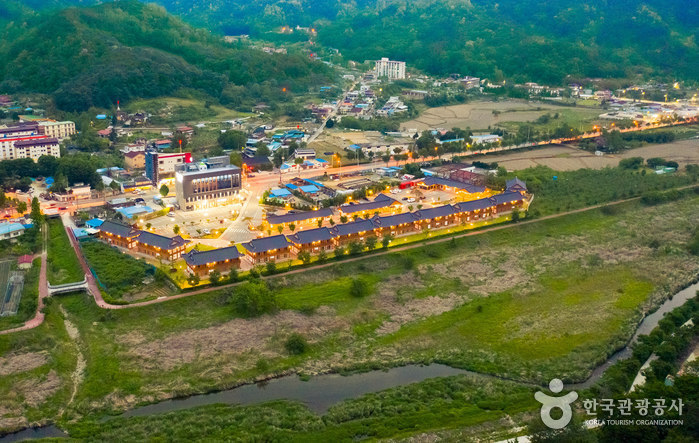
This hanok (traditional Korean house) hotel shows a different interpretation of hanok’s traditional beauty from Jeonju Hanok Village. The name of the hotel encapsulates Jeonju’s spirit as a city of tradition and art, and the exemplar of the state of Joseon. The hotel complex stands on a plot of land spanning 19,840 m2, containing 11 residential buildings and other facilities like hanok restaurants. Each residential building is named after the kings of the Joseon Dynasty. Jeongjogwan contains six rooms,
all built to modern comfort for all age groups. Grade 2 Silver and Gold Rooms, which can house up to 6 guests, are especially popular for families. The rooms combine modern comfort with hanok aesthetics, like wooden exposed beams and wooden furniture, which help to fill the room with the elegant fragrance of wood.
The hotel has about 150 parking spots, a hanok cafe, and the Convention Center with spaces such as Daejanggeum Hall, Saimdang Hall, Chungmugong Hall, and Hunminjeongeum Hall. Samtaegeuk and Samjogo Restaurants are designated as COVID-19 Safe Restaurants by the city of Jeonju. Jeonju Hanok Village is reachable by car in about 7 min.
Sukjonggwan of the Royal Room/ 왕의지밀 숙종관
14.2Km 2025-08-11
5218-14, Chunhyang-ro, Wansan-gu, Jeonju-si, Région Jeonbuk
+82-63-284-1004
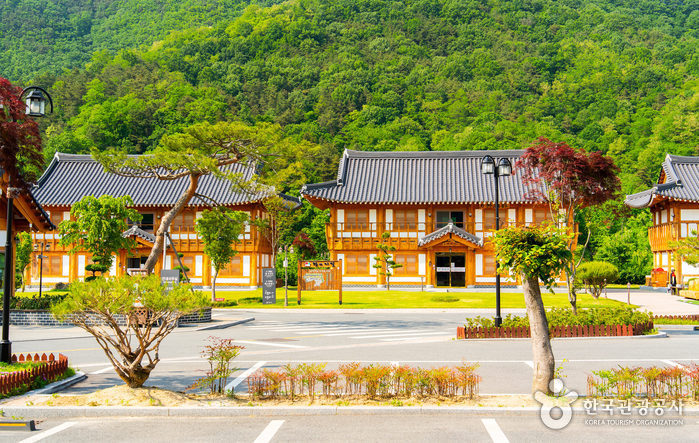
This hanok (traditional Korean house) hotel combines the unique aesthetics of hanok and modern comfort. Its location near Jeonju Hanok Village, the central point of Jeonju tourism, gives it excellent access to destinations in Jeonju. As evident from its name, the hotel promises a comfortable stay in a hanok since its opening in 2018. The hotel complex stands on a plot of land spanning 19,840 m2, containing 11 residential buildings that are named after the Joseon kings and other facilities.
The building Sukjonggwan contains four rooms. Each room is a self-contained unit made up of bedrooms and restrooms, furnished with a combination of hanok’s unique charms and modern comfort. Grade 1 Gold and Silver Rooms in particular have two beds and a whirlpool bathtub for the comfort of the guests. The view of the wooden exposed beams (Gold Room) speaks to the unique characteristics of hanok, while wooden pieces of furniture give the room an elegant finish. The scenery beyond the window wall is also the pride of the hotel.
The hotel has about 150 parking spots, a hanok cafe, and the Convention Center with spaces such as Daejanggeum Hall, Saimdang Hall, Chungmugong Hall, and Hunminjeongeum Hall. Samtaegeuk and Samjogo Restaurants are designated as COVID-19 Safe Restaurants by the city of Jeonju. It takes only 10 min by car to reach most tourist sites in Jeonju Hanok Village.
Omokdae et Imokdae (오목대와 이목대)
14.2Km 2025-08-12
1-3, Gyodong 1-ga, Wansan-gu, Jeonju-si, Région Jeonbuk
+82-63-281-2114
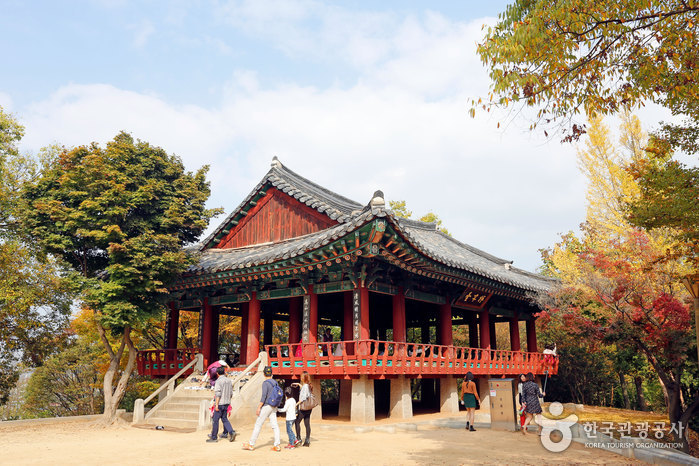
Omokdae, situé en haut d'une colline est le lieu où Yi Seong-gye (qui devint plus tard le Roi Taejo) s'arreta pour célébrer sa victoire lors d'une bataille contre l'armée japonaise au Mont Hwangsan à Unbong vers la fin de la période Goryeo. C'est aussi là où Mokjo, l'un des ancêtres de Yi Seong-gye, vécut. Plus tard, le Roi Gojong y établit une statue monumentale, “Taejogohwang Jejupilyujibi” avec une phrase écrite de sa propre main. De l'autre côté de Yukgyo, à partir d'Omokdae, se trouve Yimokdae, au pied du Mont Seungamsan où Chimyeongjasan, sité sacré pour les catholiques demeure. A 80 m de Yimokdae se trouvent un mémorial et une maison. “Mokjodaewang Gugeoyuji”, la phrase gravée sur le monument en pierre, fut écrite par le Roi Gojong en personne. Mokjo est le cinquième ancêtre du Roi Taejo, qui fonda la Dynastie Joseon. Imokdae est connue pour être le lieu où Mokjo vécut, jouant à des jeux de formation de bataille avec ses amis étant enfant. Cette anecdote apparait également dans le Yongbieocheonga (ballade du 15e siècle narrant la longévité nationale et la réussite culturelle). Mokjo se rendit à Hamgyeong-do à partir d'Imokdae (à Jeonju) en raison de la querelle qu'il eut avec le Jeonju Busan (officiel de l'etat gouvernant la région de Jeonju). Yi Seong-gye pensa que le départ de Mokjo était quelque chose ayant été guidé par les dieux afin qu'il (Yi Seong-gye) puisse fonder Joseon et devenir le premier roi de la dynastie.
Restaurant spécialisé en soupe de germes de soja Waengi – Jeonju (전주 왱이콩나물국밥전문점)
14.2Km 2025-07-14
88, Dongmun-gil, Wansan-gu, Jeonju, Province spéciale autonome du Jeolla du Nord
063-287-6980
La phrase inscrite sur l’enseigne « Même pendant votre sommeil, notre bouillon continue de mijoter » attire immédiatement l’attention : elle exprime la confiance du lieu dans la qualité de son bouillon, ainsi que la volonté d’accueillir ses clients avec soin et générosité.
Le restaurant Waengi Kongnamul Gukbap, surnommé « maison Waengi » car toujours bondé et animé (d’où le surnom « Waengi », évoquant un bourdonnement), prépare son célèbre gukbap aux germes de soja en mélangeant à parts égales un bouillon parfumé aux anchois et de l’eau, puis en y ajoutant des germes de soja biologiques cultivés sous contrat, du kimchi fermenté et quelques fruits de mer.
Reconnu depuis de nombreuses années pour ce seul et unique plat, il séduit par son goût à la fois doux, savoureux et légèrement atypique. Le bouillon, préparé sans exhausteurs de goût, offre une saveur claire et rafraîchissante.
Idéalement situé à l’intersection culturelle de Dongmun, où se concentrent de nombreux artistes et créateurs, le restaurant se trouve à proximité immédiate du quartier Hanok, mais aussi des quartiers culturels et artistiques de Jeonju, ainsi que de la rue de la mode et de la rue du cinéma, tous accessibles à pied.
Sejonggwan of the Royal Room / 왕의지밀 세종관
14.3Km 2025-08-12
5218-22, Chunhyang-ro, Wansan-gu, Jeonju-si, Région Jeonbuk
+82-63-284-1004
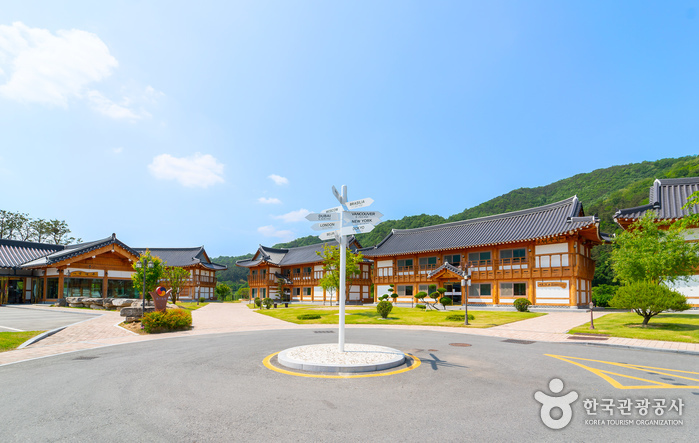
This hanok (traditional Korean house) hotel is located near Jeonju Hanok Village. The hotel has enjoyed great popularity among the tourists visiting Jeonju since its opening in 2018, for its convenient location of only a 7-min drive away from Jeonju Hanok Village and its faithful recreation of hanok’s beauty with modern sensibilities. The hotel complex stands on a plot of land spanning 19,840 m2, containing 11 residential buildings and other facilities. As the name of the hotel indicates, each building in the hotel is named after the kings of the Joseon Dynasty.
Sejonggwan is named after King Sejong. Sejonggwan has eight rooms, divided between Gold and Silver Rooms. Each room is a self-contained unit made up of bedrooms and restrooms, furnished with a combination of hanok’s unique charms and modern comfort. The view of the wooden exposed beams (Gold Room), paintings on the wall, and the view of the nature beyond the window wall recreate the unique scenery of the hanok, while amenities such as TV, refrigerator, and air conditioning offer a comfortable stay.
Other facilities inside the hotel complex include the spacious parking lot, an elegant hanok cafe, and the Convention Center, housing family-size Daejanggeum Hall and Hunminjeongeum Hall, a large hall suited for seminars. It takes only 10 min by car to reach any tourist sites near Jeonju Hanok Village from the hotel.
Jeonju Hyanggyo (école confucéenne) (전주향교)
14.3Km 2025-08-12
139, Hyanggyo-gil, Wansan-gu, Jeonju-si, Région Jeonbuk
+82-63-288-4548
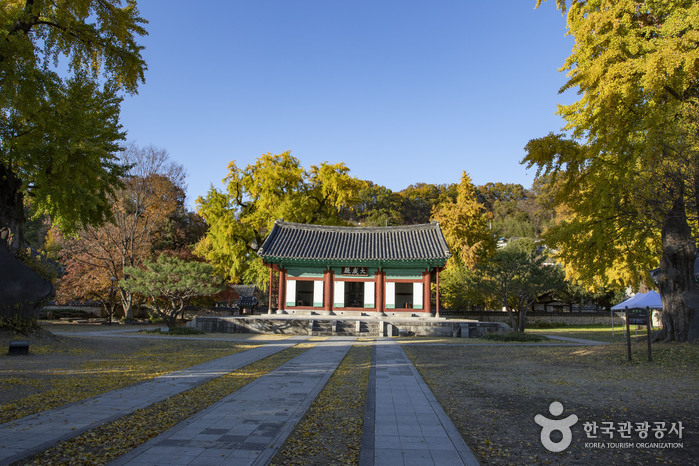
Fondée durant la dynastie Joseon (1392-1910), Jeonju Hyanggyo a été déclarée site historique n° 379. Signifiant « école provinciale », Hyanggyo était un établissement national d’éducation installé en province qui fournissait des enseignements confucianistes pendant la dernière dynastie coréenne. L’école confucéenne de Jeonju était située originairement aux alentours du lieu saint Geonggijeon, mais elle a été déplacée à son endroit actuel en 1603.
Elle abrite les plaques commémoratives de sept confucianistes chinois, y compris Confucius, et de dix-huit savants coréens dans le bâtiment principal appelé Daesungjeon. Composée de ce bâtiment et de seize autres, cette école figure parmi les plus grands établissements d’éducation de par sa taille.
Sunjonggwan of the Royal Room / 왕의지밀 순종관
14.3Km 2025-08-13
5218-6, Chunhyang-ro, Wansan-gu, Jeonju-si, Région Jeonbuk
+82-63-284-1004
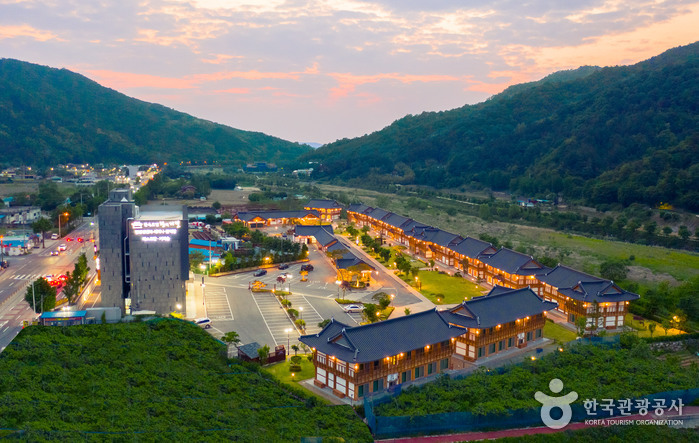
This hanok (traditional Korean house) hotel is located near Jeonju Hanok Village. The hotel complex stands on a plot of land spanning 19,840 m2, containing 11 residential buildings and other facilities. Modern hanok buildings are built on a line, blending with the surrounding nature to offer a comfortable stay. The name of the hotel is evident in the 11 residential buildings, all named after the kings of the Joseon Dynasty.
Sunjonggwan has six rooms in total. The rooms are divided into Gold and Silver Rooms, and are classified into Grade 2, Grade 3, and Grade 5 rooms, after the grading system used for government officials during the Joseon Period. Gold Rooms are located on the second floor, while the 1st floor is occupied by the Silver Rooms. Each room is furnished with a combination of hanok’s unique charms and modern comfort. Exposed wooden beams fill the room with a gentle scent of wood, while window walls offer an expansive view of the scenery outside.
Restaurants such as Samtaegeuk Restaurant, the site of the hotel’s breakfast offering, and Samjogo Restaurant, a Korean restaurant serving lunch and dinnertime, are designated as COVID-19 Safe Restaurants by the city of Jeonju. The Convention Center, which houses a hanok cafe, also offers a number of different facilities for the guests. It takes only 10 min by car to reach most tourist sites in Jeonju.
 Français
 한국어
한국어 English
 日本語
日本語 中文(简体)
 Deutsch
 Español
 Русский


