
National Theater of Korea (국립극장)
1.0Km 2024-03-06
59, Jangchungdan-ro, Jung-gu, Seoul
+82-2-2280-4114
The National Theater of Korea opened in 1950 as the first national theater in Asia. It is the only production theater that takes traditional arts to recreate them as contemporary art. It offers various types of theaters, such as Haeoreum Grand Theater, Daloreum Theater (middle-size), Immersive Studio ByeolByeol (small-size), and Haneul Round Theater with a circular stage structure. In addition, the Museum of Performing Arts, Cultural Plaza, and other convenience stores and coffe shops offer pleasure and relax to its visitors.
Yejiwon (예지원)
1.0Km 2022-09-19
72, Jangchungdan-ro, Jung-gu, Seoul
+82-2-2253-2211
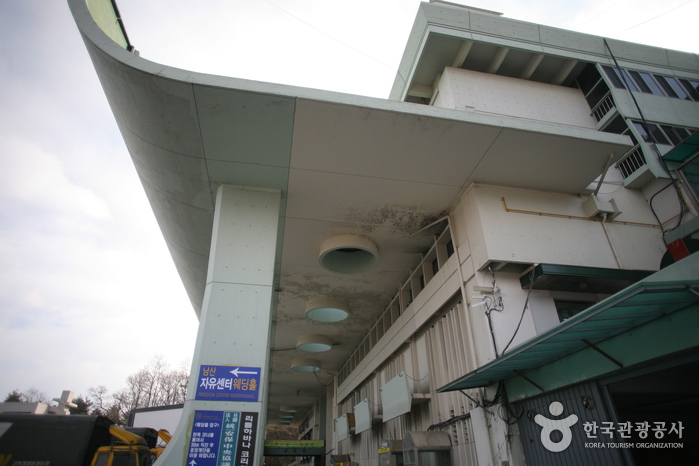
The Yejiwon is located in Seoul Jung-gu Jangchung-dong and has been offering traditional Korean etiquette education programs since its inception on September 16th, 1974. Furthermore, the Yejiwon also serves to introduce the traditional cultures and living cultures of Korean etiquettes to foreigners.
Most programs offered are short-term classes, and reservations can be made on the homepage up to 15 days in advance. Reservations are only available for groups of 10 or more and classes are instructed in Korean only, so it may be a good idea to be accompanied by a guide.
Korea House (한국의집)
1.0Km 2025-10-23
10, Toegye-ro 36-gil, Jung-gu, Seoul
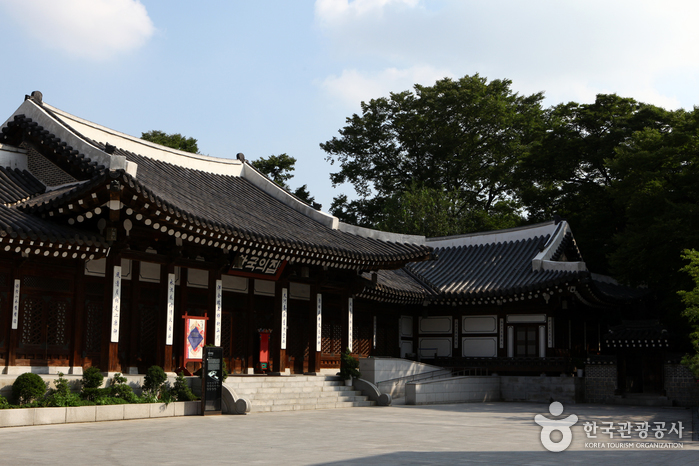
The Korea House was opened in 1981. It is a traditional Korean building that introduces the culture and lifestyle of Koreans, where you can experience traditional architecture and a classical atmosphere. The building was built in the style of the Joseon Dynasty's Jagyeong-jeon building at the Gyeongbok Palace. It is the only building built in the traditional architectural style. You will feel its antiquity as you enter the building.
It is divided into the Haerin-gwan (a space for people to get acquainted with each other), the Traditional Theater, and three annex buildings (Munhyang-ru, Nokeum-jeong and Cheongwu-jeong). At Haerin-gwan, you can enjoy traditional music at Garak-dang and try traditional food at Sohwa-dang. In the square of Garak-dang you can view a traditional wedding (on the weekends) or people playing folk games. Also, at the Traditional Theater, about 156 seats are available, and in the afternoons Human Cultural Assets or members of the National Center for Korean Traditional Performing Arts and the National Corps members present traditional music and dances. Sinayui, Salpuri, Pansori, the Drum Dance and the Bongsan Mask Dance are the most popular programs for foreigners. The programs are all explained in English and Japanese.
In the Cultural Gift Shop you can view various crafts made by traditional craftsmen. It is always open and the crafts are for sale as well. There are pottery, ceramics, golden crafts, knots and embroidery etc; approximately 500 pieces of artwork made by craftsmen from 20 different fields. Next to the House of Korea is the Namsan-gol Hanok Village where visitors can explore traditional houses.
Pyounghwa (Pyeonghwa) Fashion Town (서울 평화시장)
1.0Km 2025-01-06
274, Cheonggyecheon-ro, Jung-gu, Seoul
+82-2-2265-3531~3
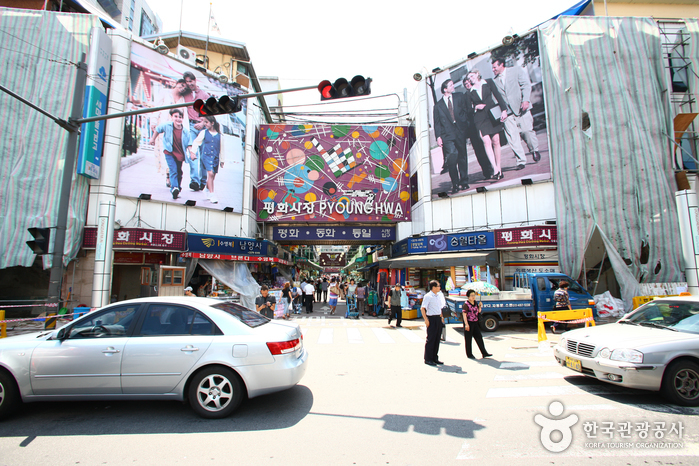
The Pyounghwa Fashion Town market in Dongdaemun has been selling fashion clothing and accessories for over 50 years ever since the end of the Korean War. It was here that in 1953 North Korean refugees started selling clothes made from US army uniforms. Their market was then named Pyounghwa, which means peace, in the hope that no other wars would be fought on Korean soil. The Pyounghwa Fashion Town was therefore the beginning of the 30,000 stores that now make up Dongdaemun Fashion Town, which is seen as one of the global centers of the fashion industry.
Spread over a large area, this historical fashion market is divided into several districts, the ‘Gu Pyounghwa Fashion Town’ is the oldest, and there is also the ‘Shin Pyounghwa Fashion Town’, ‘Dong Pyounghwa Fashion Town’, and ‘Cheong Pyounghwa Fashion Town’.
Bangsan Wholesale Market (방산 종합시장)
1.0Km 2025-10-23
20, Dongho-ro 37-gil, Jung-gu, Seoul
+82-2-2268-6691
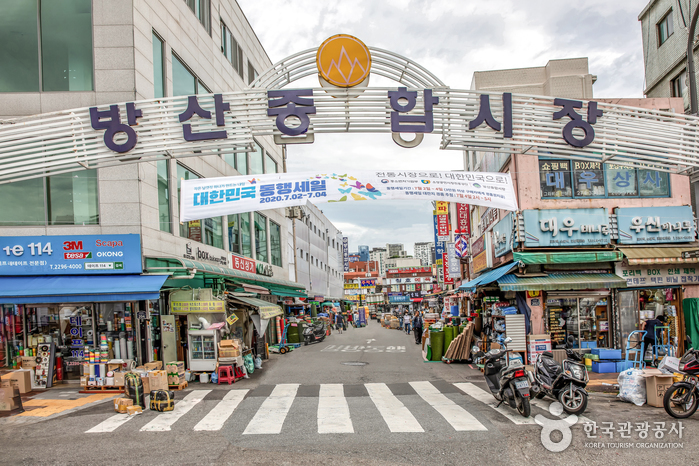
Bangsan Market is a wholesale market with approximately 250 stores that sells packaging and promotional materials. The market was popular with patissiers in the past and is currently more famous for being a bakery street.
Cheonggyecheon Stream (청계천)
1.1Km 2024-05-16
Changsin-dong, Jongno-gu, Seoul
+82-2-2290-7111
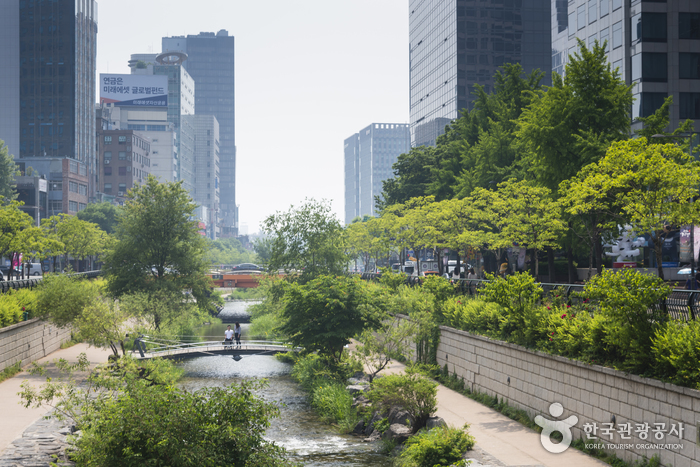
Cheonggye Plaza was built on Sejong-ro Street, where Cheonggyecheon Stream begins. It was built between Dong-A Ilbo, the starting point of the Cheonggyecheon Stream restoration, and Sindap Railroad Bridge, with a length of 160 meters, a x_width of 50 meters, and a total area of 6,962 meters squared. The plaza is decorated with fountains, waterfalls, and walking paths. It was created as a place for meetings, harmony, peace, and unification, to celebrate the significance of the restoration of Cheonggyecheon Stream. A miniaturized version of Cheonggyecheon Stream is displayed here, providing an overview of the restored stream. There are also interpretive panels about the 22 bridges that cross Cheonggyecheon stream. Fountains of various shapes create beautiful scenery. Cheonggyecheon Stream is accessible from the square through stairs on the left and Cheonggye Trail on the right. There is also an 18-meter tunnel on the Cheonggye Trail, providing a unique experience for citizens entering Cheonggyecheon Stream from the plaza. After constructing Cheonggyecheon Plaza, the Seoul Metropolitan Government made it a car-free street on public holidays so that the plaza, waterside area, and streets could be used as cultural spaces for citizens to relax. A spectacular sight is created by three-color lights illuminating the fountains and a two-tiered waterfall coming down from a x_height of four meters. Palseokdam, made of eight stones from eight provinces in Korea, was laid along the waterfall's sides.
Haepungbuwongun Yun Taekyeong's Jaesil (해풍부원군윤택영댁재실)
1.1Km 2021-11-10
28, Toegye-ro 34-gil, Jung-gu, Seoul
+82-2-3396-5882
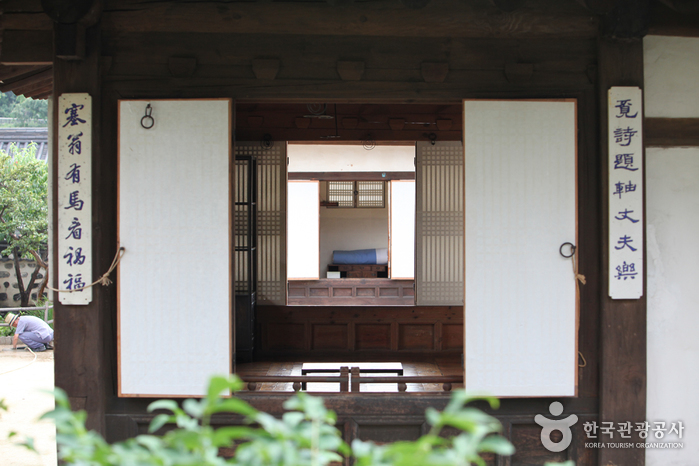
Haepungbuwongun Yun Taekyeong's Jaesil is a shrine house built by the father-in-law of King Sunjong of Joseon dynasty in 1906 when his daughter was proclaimed the crowned princess of Joseon and entered Changdeokgung Palace to later become Queen Sunjeong. Red pine trees salvaged from the demolition of Gyeongungung Palace were used to construct the house. It was originally located in Jegi-dong, Dongdaemun-gu, but was later restored and moved to its present location. The shrine of the house that was destroyed in 1960 was also restored.
Because the house is more of a shrine rather than residential living quarters, it has many unique features. For example, unlike other houses, it has the anchae (women’s quarters) located across from sarangbang (men’s quarters) with daecheong (living room) positioned between them.
Namsangol Hanok Village (남산골한옥마을)
1.1Km 2025-07-14
28 Toegye-ro 34-gil, Jung-gu, Seoul
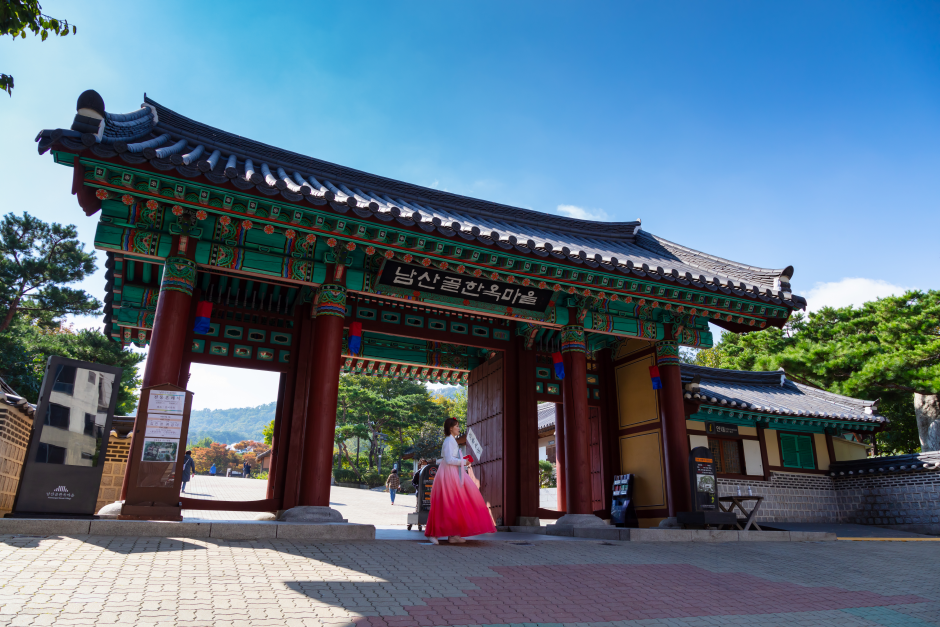
Namsangol Hanok Village opened in 1998 on the northern side of Namsan Mountain in the center of the capital. This village has five restored hanok (traditional Korean house) premises, a pavilion, a traditional garden, a performance art stage, and a time capsule plaza, making it a perfect spot for locals and tourists to take a leisure walk. Upon entering from the front gate, visitors will get a taste of Korea's traditional life while escaping from bustling city life. The traditional garden with its pavilion and old houses creates a peaceful ambiance before the forested Namsan Mountain. A time capsule commemorating Seoul’s 600th anniversary was buried in 1994 at the highest point of the village and is scheduled to be reopened 400 years later in 2394.
The five hanok premises at Namsangol Hanok Village once belonged to aristocrats and government officials of the Joseon dynasty. Each house was originally located in a different neighborhood, but they were all moved to this area and restored to their original form. The houses were rebuilt using their original materials, except for one house, where the materials were too old and deteriorated to be reused. The premises were carefully restored and replicated according to their original form to depict the owners’ social class and personality. These buildings are now used as an exhibit to portray the living environment during the Joseon dynasty and as a venue for educational and cultural programs for children and tourists.
Some of the unique programs and activities to participate in include wearing hanbok, folding hanji (traditional Korean paper), writing in Korean, traditional tea ceremony, traditional etiquette school, and herbal medicine experience. There are also taekwondo demonstrations and other various performances held around the village. Visitors can also try traditional games such as yunnori (traditional board game), or understand more about the area through a guided tour.
![Black Yak - Jongno Branch [Tax Refund Shop] (블랙야크 종로)](http://tong.visitkorea.or.kr/cms/resource/32/2878232_image2_1.jpg)
Black Yak - Jongno Branch [Tax Refund Shop] (블랙야크 종로)
1.1Km 2024-04-22
22, Jong-ro 36-gil, Jongno-gu, Seoul
-
Eunjujeong (은주정)
1.1Km 2024-03-12
32, Changgyeonggung-ro 8-gil, Jung-gu, Seoul
+82-2-2265-4669
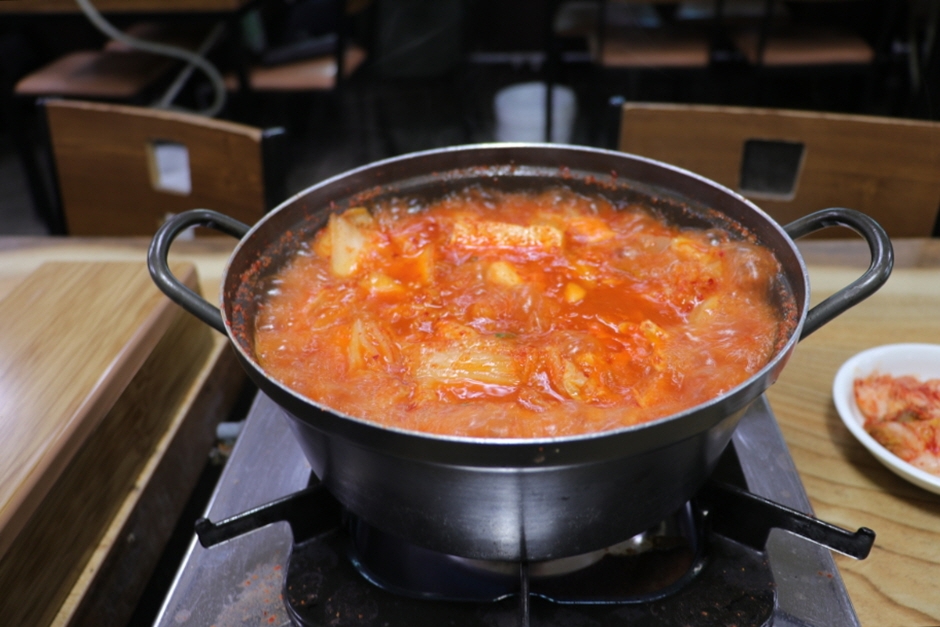
Situated near Gwangjang Market, Eunjujeong focuses on kimchi jjigae. Served wrapped in lettuce, it offers a unique delicacy. They also sell barbecued pork belly, which is grilled in the traditional Korean style. After finishig the meal, it's recommended to take a walk along Cheonggyecheon Stream right in front of the restaurant. Across Cheonggyecheon Stream is Gwangjang Market, which is also worth exploring, enriching the experience of the area.
 English
 한국어
한국어 日本語
日本語 中文(简体)
 Deutsch
 Français
 Español
 Русский


