![ABC Mart - Sangbong Branch [Tax Refund Shop] (ABC마트 상봉점)](http://tong.visitkorea.or.kr/cms/resource/40/3314140_image2_1.jpg)
ABC Mart - Sangbong Branch [Tax Refund Shop] (ABC마트 상봉점)
9.7Km 2024-06-27
353, Mangu-ro, Jungnang-gu, Seoul
-

Wecle - Yeouido Branch [Tax Refund Shop] (위클 여의도)
9.7Km 2024-04-18
Store #B119, B1 (Yeouido-dong), 16, Gukjegeumyung-ro 8-gil, Yeongdeungpo-gu, Seoul
-
Davich Optical - Mia Sageori Branch [Tax Refund Shop] (다비치안경 미아사거리)
9.7Km 2024-04-22
1F, 3, Wolgye-ro, Gangbuk-gu, Seoul
-
![Olens - Sinchon Myeongmul Street Branch [Tax Refund Shop] (오렌즈 신촌명물)](http://tong.visitkorea.or.kr/cms/resource/05/2888205_image2_1.jpg)
Olens - Sinchon Myeongmul Street Branch [Tax Refund Shop] (오렌즈 신촌명물)
9.7Km 2024-04-17
1F, 18, Myeongmul-gil, Seodaemun-gu, Seoul
-
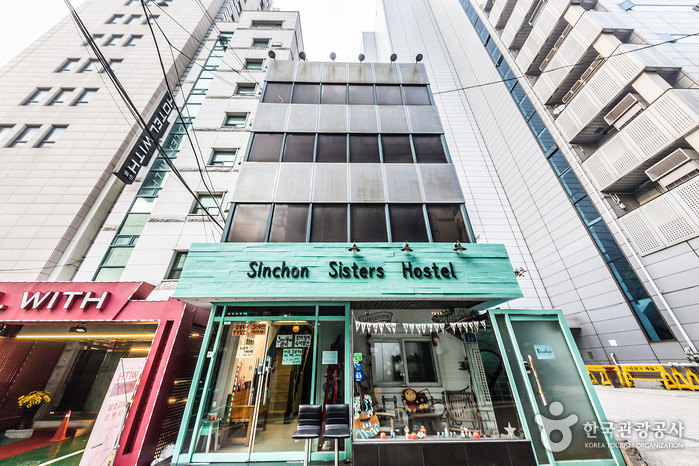
Sinchon Sisters Hostel (신촌 시스터즈)
9.7Km 2024-12-23
24 , Baekbeom-ro 2-gil, Mapo-gu, Seoul
+82-10-4354-1613
Sinchon Sisters is a friendly guesthouse in Mapo-gu, Seoul, that caters for young travelers. Rooms are for two, three or four people, and each room has its own bathroom. There is no separate dining area, but you can bring food into your room and there’s a microwave for visitors’ use. Washing machines and dryers are also provided (payment needed). Transport is convenient: Sinchon Station and Sogang University Station are a 5 minutes’ walk away, and there are bus stops nearby - including for the airport express bus service. The Hongdae, Hapjeong, Mangwon, and Sangsu areas are all nearby.
![ABC-Mart - Sinchon Branch [Tax Refund Shop] (ABC마트 GS신촌점)](http://tong.visitkorea.or.kr/cms/resource/95/2890495_image2_1.jpg)
ABC-Mart - Sinchon Branch [Tax Refund Shop] (ABC마트 GS신촌점)
9.7Km 2024-04-22
6, Myeongmul-gil, Seodaemun-gu, Seoul
-
Artbox - Sinchon Branch [Tax Refund Shop] (아트박스 신촌)
9.7Km 2024-04-22
1F, 23, Myeongmul-gil, Seodaemun-gu, Seoul
-
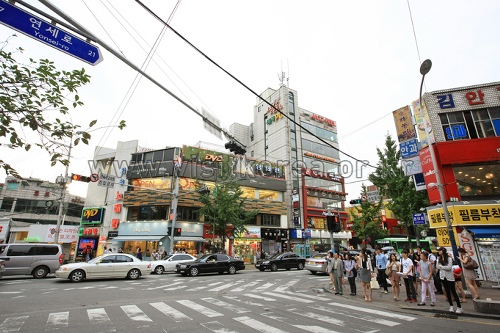
Yeonsero (Yonsei University Street) (연세로)
9.7Km 2022-10-25
Area of Yeonse-ro, Sedaemun-gu, Seoul
+82-2-120
This road takes you from Sinchon Subway Station right to Yonsei University. Like branching tree roots, the numerous side streets diverge off the main road. In 1999 Yonsei College Street was designated as “The Road One Wants to Walk.” Since then, this famous street has been improved upon even more, placed on tourist maps and promoted by businesses. A visitor to this area can eat at a plethora of restaurants, coffee shops and stores. In the afternoon hours, you can also enjoy the taste of small food stands that line the sidewalks.

The Hyundai Seoul (더현대 서울)
9.7Km 2024-07-22
108 Yeoui-daero, Yeongdeungpo-gu, Seoul
The Hyundai Seoul, an ultra-modern flagship store, is located in the heart of Seoul, the center of globally trending K-content. Under the slogan of "Echoes for the Future," The Hyundai Seoul presents the vision for a happier tomorrow and standards for new life. Featuring an innovative design of spaces, global content curation, and, even, futuristic technologies, The Hyundai Seoul is the most prominent new global landmark in Seoul. At The Hyundai Seoul, the latest global trends in interior and architectural design can be witnessed from encounters with novel materials, the balance between planes and lines, and creative interior design filled with light. As soon as one steps into The Hyundai Seoul, the Sounds Forest and Waterfall Garden welcome them with open arms. This incredible piece of nature encountered in such a high-tech structure designed for the future is amazingly beautiful. A vast 3,306-square-meter indoor garden with natural grass and sunlight falling through the glass ceiling located some 20 meters high delivers echoes of a forest to all visitors. Art is a language in the broadest category that can be felt and empathized with without speaking. A large 595-square-meter three-dimensional exhibit instantaneously and overwhelmingly stimulates inspiration as soon as one enters. Inspiration for better lives and communication for culture start here. An artwork by Studio Swine designed with a message from nature - Unite & Shine, STUDIO SWINE - and appreciated by the audience that feels and enjoys it meets with high-end brands on the Exclusive Label (1F) floor.
![Nature Collection - Sinchon Branch [Tax Refund Shop] (네이처컬렉션 신촌)](http://tong.visitkorea.or.kr/cms/resource/87/2878287_image2_1.jpg)
Nature Collection - Sinchon Branch [Tax Refund Shop] (네이처컬렉션 신촌)
9.7Km 2024-04-18
14, Yonsei-ro, Seodaemun-gu, Seoul
-
 English
 한국어
한국어 日本語
日本語 中文(简体)
 Deutsch
 Français
 Español
 Русский


