![Banwol Audio [Tax Refund Shop] (반월음향)](http://tong.visitkorea.or.kr/cms/resource/18/2891218_image2_1.jpg)
![Audio Park - Yongsan ETLand Branch [Tax Refund Shop] (오디오파크 용산전자랜드)](http://tong.visitkorea.or.kr/cms/resource/92/2878492_image2_1.jpg)
Audio Park - Yongsan ETLand Branch [Tax Refund Shop] (오디오파크 용산전자랜드)
7.0Km 2024-04-22
74, Cheongpa-ro, Yongsan-gu, Seoul
-
![Choi Com - Yongsan ETLand Branch [Tax Refund Shop] (초이컴 용산전자랜드)](http://tong.visitkorea.or.kr/cms/resource/00/2878500_image2_1.jpg)
Choi Com - Yongsan ETLand Branch [Tax Refund Shop] (초이컴 용산전자랜드)
7.0Km 2024-04-18
Store #A-335, 3F, ET LAND (Main Bldg.), 74, Cheongpa-ro, Yongsan-gu, Seoul
-
![Dongshin Electronics - Yongsan ETLand Branch [Tax Refund Shop] (동신전자 용산전자랜드)](http://tong.visitkorea.or.kr/cms/resource/03/2878503_image2_1.jpg)
Dongshin Electronics - Yongsan ETLand Branch [Tax Refund Shop] (동신전자 용산전자랜드)
7.0Km 2024-04-18
Store #B-11, #B-18, ET LAND Main Bldg. Plaza, 74, Cheongpa-ro, Yongsan-gu, Seoul
-
![TNT Info - Yongsan ETLand Branch [Tax Refund Shop] (티앤티정보 용산전자랜드)](http://tong.visitkorea.or.kr/cms/resource/86/2878486_image2_1.jpg)
TNT Info - Yongsan ETLand Branch [Tax Refund Shop] (티앤티정보 용산전자랜드)
7.0Km 2024-04-17
ET LAND (Main Bldg )3층A- 304.319, 74, Cheongpa-ro, Yongsan-gu, Seoul
-
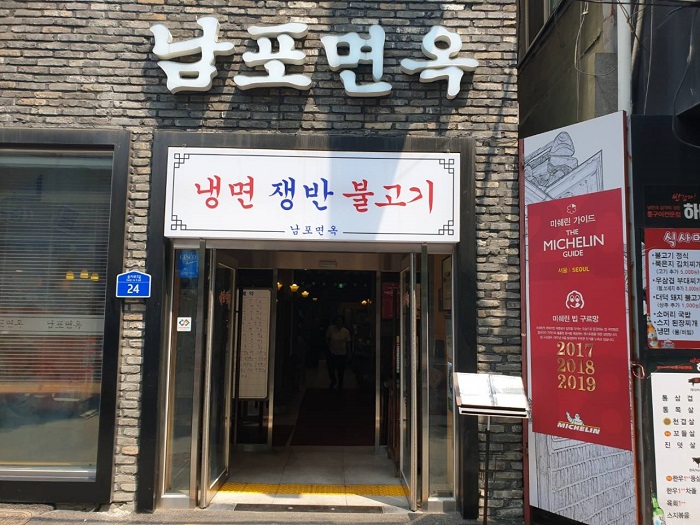
Nampo Myeonok (남포면옥)
7.0Km 2024-03-07
24, Eulji-ro 3-gil, Jung-gu, Seoul
+82-2-777-3131
Located near Seoul City Hall and Cheonggyecheon Stream, Nampo Myeonok is a traditional Korean restaurant. Opened in 1968, it has been recognized by the Michelin Guide several times. Their specialty is pyeongyang naengmyeon (pyeongyang cold buckwheat noodles). The restaurant also serves a variety of other dishes that are the most commonly found in Korea, including galbi tang (galbi soup), bulgogi, mandu soup, and yukgaejang (spicy beef soup).

Jalppajin Memil Ikseon Branch (잘빠진메밀 익선)
7.1Km 2024-03-18
73 Yulgok-ro 8-gil, Jongno-gu, Seoul
+82-70-4531-1214
Jalppajin Memil is a specialty restaurant that directly kneads 100% buckwheat dough to make buckwheat noodles. They offer both bibim makguksu (spicy buckwheat noodles) and mul makguksu (buckwheat noodles). Additionally, they serve memil jeonbyeong (buckwheat crepe), memil mandu (buckwheat mandu), and tender suyuk (boiled pork slices). They have a selection of 10 different kinds of makgeolli (unrefined rice wine) including chestnut, citrus, corn, and mulberry, allowing customers to choose according to their preference. Their famous makgeolli sampler set, which allows customers to taste five different types of makgeolli in small quantities, is popular.
Seoul Hyochang Park (서울 효창공원)
7.1Km 2024-07-09
177-18 Hyochangwon-ro, Yongsan-gu, Seoul
+82-2-2199-7608
Hyochang Park covers 122,245 square meters spanning across Hyochang-dong and Cheongpa 2-dong. It is a historic landmark that once contained several royal tombs, and was known at that time as Hyochangwon. The cemeteries that were originally located in Hyochangwon belonged to Crown Prince Munhyo, King Jeongjo’s first son who died at the age of five; Royal Noble Consort Uibin of the Seong Clan, King Jeongjo’s royal concubine and Crown Prince Munhyo’s mother; Royal Noble Consort Sugui of the Park Clan, King Sunjo’s royal concubine; and her daughter Princess Yeongon. The royal tombs were moved to Seooreung Tombs in the waning months of the Japanese colonial period. The Japanese empire began the development of Hyochangwon into a park in 1924, and the Japanese governor-general officially assigned the site as a park in 1940.
Presently, several of Korea’s greatest leaders are buried in Hyochang Park. The remains mostly belong to independence activists including Yoon Bong-gil, Lee Bong-chang, and Baek Jeong-gi, whose graves are collectively known as Samuisa Tomb. A statue of Lee Bong-chang has been built in the graveyard. Among the other patriotic martyrs who are interred in the park are Kim Gu and some of the key figures of the provisional government such as Lee Dong-nyeong, Cha I-seok, and Cho Seong-hwan. An ancestral shrine named Uiyeolsa has been built along the main gate and holds the portraits of the deceased independence activists.
![Olive Young - City Hall Station Branch [Tax Refund Shop] (올리브영 시청역)](http://tong.visitkorea.or.kr/cms/resource/77/2878577_image2_1.jpg)
Olive Young - City Hall Station Branch [Tax Refund Shop] (올리브영 시청역)
7.1Km 2024-04-22
1, Sejong-daero 16-gil, Jung-gu, Seoul
-
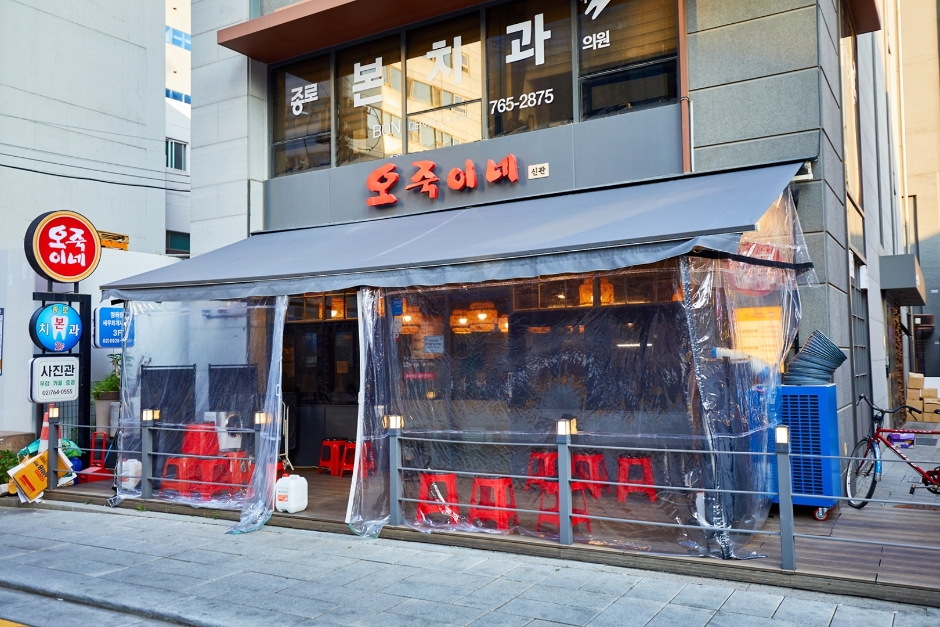
Ojugine (오죽이네)
7.1Km 2024-12-10
Ojugine is a restaurant that specializes in dak maeuntang, a spicy chicken stew that is different from dak bokkeumtang (spicy braised chicken), as the former has more soup than the latter. The stew is served whilst boiling, so one just needs to let it sit for a bit on the table before digging in. The spicy sauce and chicken are a match made in heaven, and the same goes for this dish. Interestingly, Ojugine uses smaller chickens to prepare their dishes, so the flesh braises in the stock faster. The resulting combination is sure to offer a memorable meal. Any remaining soup can be reused as a sauce for fried rice after the main meal, so visitors are advised to leave some space in their stomach.
 English
 한국어
한국어 日本語
日本語 中文(简体)
 Deutsch
 Français
 Español
 Русский


