Heunginjimun Gate - Dongdaemun Gate (흥인지문)
7.3Km 2025-10-23
288, Jong-ro, Jongno-gu, Seoul
+82-2-2148-1842
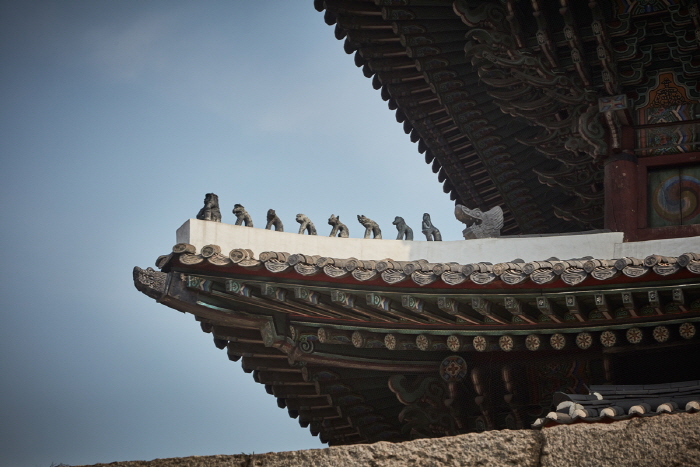
Heunginjimun Gate was built to protect Hanseongbu, which historically housed essential government facilities. Heunginjimun Gate was the gate on the east side of the outer wall of Seoul Fortress among eight gates. It is referred to as Dongdaemun Gate as well. The gate was constructed during King Taejo’s 5th year in 1396, remodeled during the reign of King Danjong in 1453, and was newly built in 1869 during the sixth year of King Gojong’s reign in 1869.
The gate features a hipped roof with five front and two side compartments on a two-storied building. The thin and weak bracket system supports the eaves and is excessively decorated, reflecting the construction features of the late Joseon period. Also, outside of the fortress is the half-circle-shaped Ongseong, a small wall, to protect the gate.
One of the unique factors of Heunginjimun Gate is that it is the only gate among Seoul’s eight to have Ongseong, further exhibiting the style of construction used during the late Joseon period.
![KGC - Dongmyo Branch [Tax Refund Shop] (KGC 동묘점)](http://tong.visitkorea.or.kr/cms/resource/91/2878191_image2_1.jpg)
![Louis Bon - Myeong-dong Branch [Tax Refund Shop] (루이본 명동)](http://tong.visitkorea.or.kr/cms/resource/50/2889050_image2_1.jpg)
Louis Bon - Myeong-dong Branch [Tax Refund Shop] (루이본 명동)
7.3Km 2024-04-22
#101, 37, Toegye-ro 20-gil, Jung-gu, Seoul
-
![Olive Young - Dongmyo Station Branch [Tax Refund Shop] (올리브영 동묘앞역)](http://tong.visitkorea.or.kr/cms/resource/87/2878187_image2_1.jpg)
Olive Young - Dongmyo Station Branch [Tax Refund Shop] (올리브영 동묘앞역)
7.3Km 2024-04-17
37-1, Jibong-ro, Jongno-gu, Seoul
-
Cheonggyecheon Stream (청계천)
7.3Km 2024-05-16
Changsin-dong, Jongno-gu, Seoul
+82-2-2290-7111
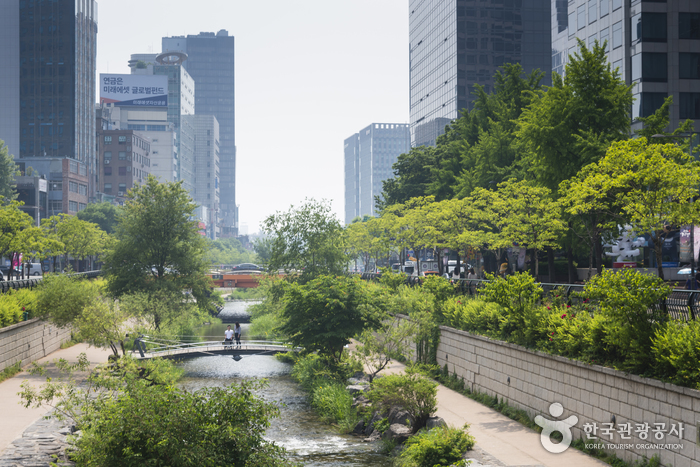
Cheonggye Plaza was built on Sejong-ro Street, where Cheonggyecheon Stream begins. It was built between Dong-A Ilbo, the starting point of the Cheonggyecheon Stream restoration, and Sindap Railroad Bridge, with a length of 160 meters, a x_width of 50 meters, and a total area of 6,962 meters squared. The plaza is decorated with fountains, waterfalls, and walking paths. It was created as a place for meetings, harmony, peace, and unification, to celebrate the significance of the restoration of Cheonggyecheon Stream. A miniaturized version of Cheonggyecheon Stream is displayed here, providing an overview of the restored stream. There are also interpretive panels about the 22 bridges that cross Cheonggyecheon stream. Fountains of various shapes create beautiful scenery. Cheonggyecheon Stream is accessible from the square through stairs on the left and Cheonggye Trail on the right. There is also an 18-meter tunnel on the Cheonggye Trail, providing a unique experience for citizens entering Cheonggyecheon Stream from the plaza. After constructing Cheonggyecheon Plaza, the Seoul Metropolitan Government made it a car-free street on public holidays so that the plaza, waterside area, and streets could be used as cultural spaces for citizens to relax. A spectacular sight is created by three-color lights illuminating the fountains and a two-tiered waterfall coming down from a x_height of four meters. Palseokdam, made of eight stones from eight provinces in Korea, was laid along the waterfall's sides.
![ER Shoopen - IPARK Mall Branch [Tax Refund Shop] (ER 슈펜 아이파크몰)](http://tong.visitkorea.or.kr/cms/resource/76/2888676_image2_1.jpg)
ER Shoopen - IPARK Mall Branch [Tax Refund Shop] (ER 슈펜 아이파크몰)
7.3Km 2024-04-19
2F, 55, Hangang-daero 23-gil, Yongsan-gu, Seoul
-
![Zara - IPARK Mall Branch [Tax Refund Shop] (자라 아이파크몰)](http://tong.visitkorea.or.kr/cms/resource/67/2889867_image2_1.jpg)
Zara - IPARK Mall Branch [Tax Refund Shop] (자라 아이파크몰)
7.3Km 2024-04-23
55, Hangang-daero 23-gil, Yongsan-gu, Seoul
-
![It Michaa [Tax Refund Shop] (잇미샤)](http://tong.visitkorea.or.kr/cms/resource/25/2891025_image2_1.jpg)
It Michaa [Tax Refund Shop] (잇미샤)
7.3Km 2024-04-19
4F I’Park Mall, 55, Hangang-daero 23-gil, Yongsan-gu, Seoul
-
![Chicor - IPARK Mall Branch [Tax Refund Shop] (시코르 용산아이파크)](http://tong.visitkorea.or.kr/cms/resource/67/3314267_image2_1.jpg)
Chicor - IPARK Mall Branch [Tax Refund Shop] (시코르 용산아이파크)
7.3Km 2024-06-27
3F, 55, Hangang-daero 23-gil, Yongsan-gu, Seoul
-
Ahn Junggeun Memorial Museum (안중근의사기념관)
7.3Km 2024-03-06
91, Sowol-ro, Jung-gu, Seoul
82-2-3789-1016
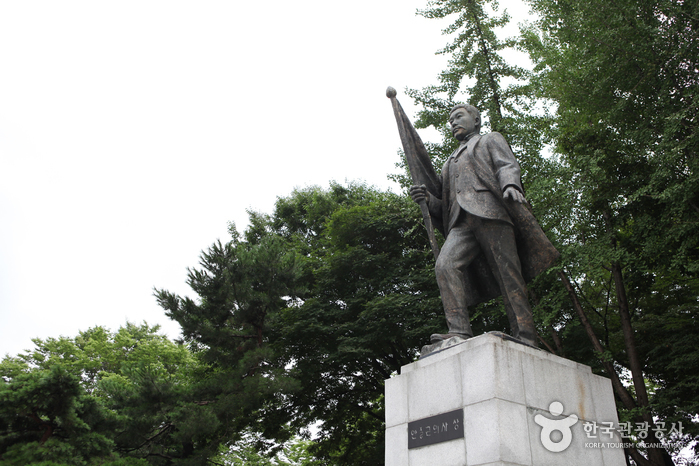
The Ahn Junggeun Memorial Museum honors the memory of Ahn Junggeun (1879-1910), an independence activist and soldier who advocated for Korean independence and peace in Asia. He fought against the Japanese to defend the Korean Empire (1897-1910). He was executed in 1910 for assassinating Hirobumi Ito, the Japanese who led the invasion of Korea in 1909, in Harbin, China.
 English
 한국어
한국어 日本語
日本語 中文(简体)
 Deutsch
 Français
 Español
 Русский


